ADULT HEALTH SERVICES PROVIDER IN WYOMING
By Fatumata Kaba · 2026-04-14 · 6 min read
SUPPORTING HEALTH, FUNCTIONAL ABILITY, AND DAILY WELLNESS FOR ADULTS WITH DISABILITIES OR AGE-RELATED CONDITIONS THROUGH PREVENTIVE AND RESTORATIVE CARE
Adult Health Services in Wyoming represent a vital segment of the state’s Home and Community-Based Services (HCBS) landscape, providing non-clinical, health-related support to individuals who require assistance to maintain independence. These services are specifically designed to help adults with disabilities, chronic health conditions, or age-related limitations improve their overall quality of life by preventing health deterioration and supporting functional daily routines within the home or community-based settings.
Covered under the Wyoming Medicaid Community Choices Waiver (CCW) and integrated into Developmental Disabilities (DD) waivers like the Comprehensive and Supports Waivers, these services act as a bridge between acute clinical care and independent living. By facilitating medication management, monitoring, and health education, provider agencies play a critical role in reducing hospital readmissions and supporting aging-in-place initiatives throughout the state.
What Are the Governing Agencies and Regulatory Roles in Wyoming?
The delivery of Adult Health Services is overseen by several state-level entities that manage funding, policy, and compliance. The Wyoming Department of Health’s Division of Healthcare Financing serves as the primary regulatory body, establishing the framework for waiver operations and ensuring that federal and state Medicaid requirements are met through consistent quality monitoring and policy updates.
Operational coordination is facilitated by Public Health Nursing (PHN) and designated Case Management Agencies. These entities are responsible for the participant’s initial and ongoing assessments, which translate specific health needs into an actionable Individualized Plan of Care (IPC). Without an approved IPC, these services cannot be billed to the Medicaid program, making the relationship between the provider and the case manager essential for service authorization.
Medicaid Provider Services manages the administrative side of the business, including the enrollment of new agencies, the processing of claims, and the issuance of prior authorizations. Agencies looking to operate in this space must ensure they remain in good standing with these departments by adhering to the rules stipulated in the waiver manuals and provider agreements.
What Scope of Care Does an Adult Health Services Provider Deliver?
Adult Health Services are categorized as non-invasive, supportive care rather than skilled nursing. The primary goal is to maintain wellness and functional capacity. While the services are not meant to replace clinical treatment by a physician, they provide the necessary supervision and structure to help participants manage their health autonomously or with minimal assistance.
Key service components commonly authorized in a plan of care include:
- Health education, including guidance on nutrition, medication routines, and chronic disease self-care.
- Supervision and daily support with Activities of Daily Living (ADLs) and fundamental health routines.
- Non-diagnostic monitoring, such as tracking weight, blood pressure, or blood glucose levels to identify trends.
- Cognitive engagement activities and memory support designed to maintain mental acuity.
- Safety checks and fall prevention strategies within the home environment.
- Assistance with health-related tasks conducted under Registered Nurse (RN) delegation, where applicable.
- Coordination with the participant's primary physician and other healthcare providers to ensure a cohesive wellness approach.
How Do Providers Navigate Licensing and Approval Requirements?
In Wyoming, formal licensure is generally not required for entities providing exclusively non-clinical, health-related support. However, this does not exempt agencies from rigorous internal controls. To function as an approved Medicaid waiver provider, an agency must demonstrate administrative competence and a commitment to participant safety through detailed internal documentation and structured business operations.
Agencies must first register the business with the Wyoming Secretary of State and obtain a Federal Employer Identification Number (EIN). Furthermore, securing a Type 2 National Provider Identifier (NPI) is essential for those intending to bill Medicaid directly. The agency is also required to draft a comprehensive Policy & Procedure Manual, which must clearly define how staff will provide care, report incidents, and maintain participant confidentiality in accordance with HIPAA standards.
If the agency intends to offer delegated health-related supports, it must establish a formal partnership with or employ a licensed Registered Nurse. This RN is responsible for the oversight of support staff and ensuring that all delegated tasks are performed safely and within the scope of the state’s nurse delegation regulations. Staffing requirements also mandate that all employees undergo thorough background checks and abuse registry clearances before interacting with participants.
What Is the Step-by-Step Wyoming Provider Enrollment Process?
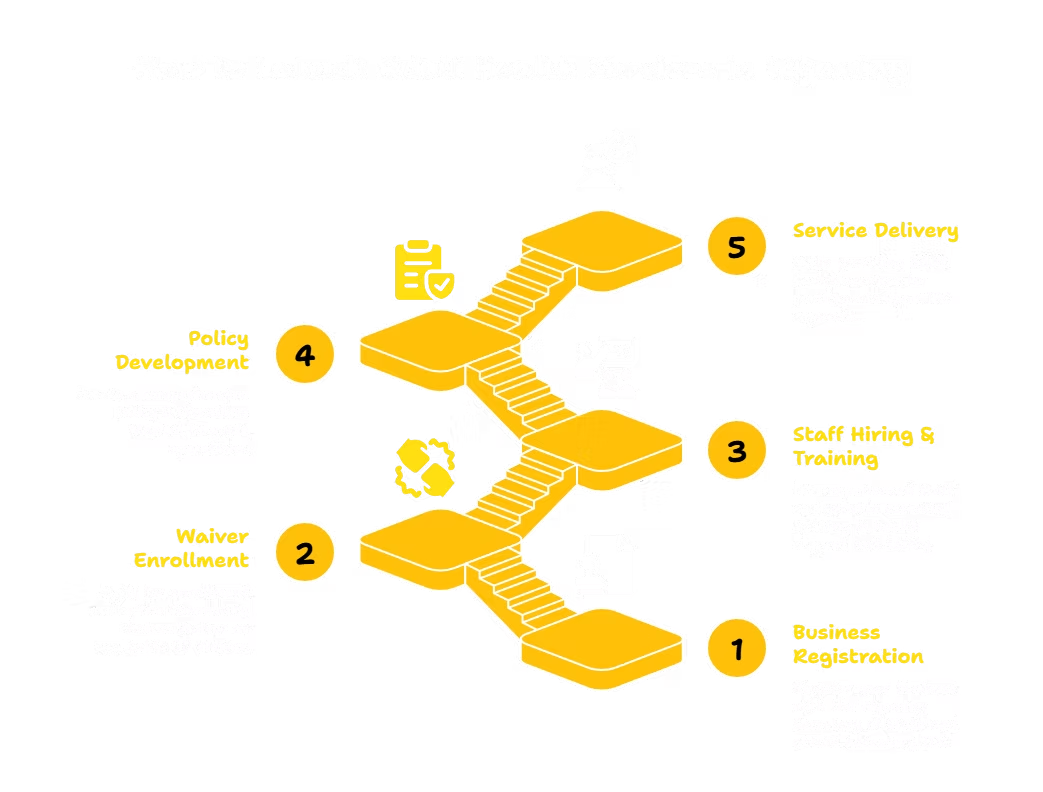
The enrollment process requires a disciplined approach to documentation and adherence to state timelines. The journey typically begins with the formal registration of the legal business entity and the acquisition of the necessary federal identifiers. Once the business foundation is laid, the agency must initiate the application for enrollment as a provider under the Community Choices Waiver or the specific DD Waiver programs.
The middle phase of the process involves the submission of credentials, service descriptions, and the previously drafted Policy & Procedure Manual to the state for review. During this period, the agency must ensure that its staff training programs are fully developed and that the agency is ready to conduct mandatory orientation for new hires. Any program-specific training required by the Division of Healthcare Financing must be completed by key administrative staff during this window.
Upon final approval, the agency becomes eligible to provide services. However, service delivery can only commence once a participant’s Individualized Plan of Care (IPC) has been approved and includes specific authorization for Adult Health Services. Providers should maintain constant communication with the participant’s case manager during the intake process to ensure that all documentation is accurate and reflects the participant’s documented functional limitations.
What Documentation Is Required to Maintain Compliance?
Compliance is a daily obligation for any Medicaid waiver provider. The state expects agencies to maintain meticulous records that substantiate every hour of service billed. Central to this is the Policy & Procedure Manual, which must act as the "living" document for the agency’s operations. This manual should cover participant intake, daily wellness support documentation, and incident reporting procedures.
Documentation requirements include, but are not limited to:
- Detailed health observation logs, including vital sign trends and notations of any significant changes in a participant's condition.
- Evidence of RN delegation protocols, documenting the training and validation of support staff for specific tasks.
- Comprehensive records of staff supervision, including performance reviews and evidence of annual training requirements.
- Formal grievance and incident reporting logs, ensuring that all safety concerns are addressed according to state guidelines.
- Transportation and community safety protocols, specifically for providers facilitating community-based wellness visits.
- Signed HIPAA and client rights acknowledgement forms to protect participant privacy.
Frequently Asked Questions
Can a provider bill for both Adult Health Services and clinical nursing?
Adult Health Services are non-clinical. If a participant requires skilled nursing, that service must be separately authorized in the IPC. Providers must be careful not to blur the lines between authorized health support tasks and skilled clinical care, as this may lead to audit findings.
Is an RN required to be on staff at all times?
An RN is not required to be on-site at all times, but they must be available to provide oversight, conduct initial health assessments, and perform the delegation of health-related tasks. The level of RN involvement depends on the complexity of the participant's needs and the requirements of the specific waiver program.
How does the timeline to launch compare for new agencies?
Establishing an agency generally takes three to six months. This includes the initial business registration, manual development, staffing, and the Medicaid enrollment phase. The most significant variables are the state’s current processing times for provider enrollment and the speed at which the agency can finalize its internal policy documentation.
Key takeaway: Success as a Wyoming Adult Health Services provider relies on the successful integration of rigorous clinical oversight—via RN delegation—with consistent administrative compliance. Agencies that prioritize the creation of robust policy manuals and maintain transparent, audit-ready documentation are better positioned to provide stable, long-term care that meets the requirements of the Community Choices and DD waiver programs.
Last verified: October 2023. Disclaimer: This article is for informational purposes only and does not constitute legal or professional medical advice. Always refer to the latest Wyoming Department of Health manuals and federal Medicaid regulations for current policy requirements.