ADULT HEALTH SERVICES PROVIDER IN NEW MEXICO
By Fatumata Kaba · 2025-09-05 · 6 min read
An Adult Health Services provider in New Mexico is a specialized healthcare entity authorized under the state's Medicaid Home and Community-Based Services (HCBS) waiver programs to deliver critical wellness and clinical support to individuals with disabilities, chronic conditions, or age-related health requirements. By integrating medical monitoring, chronic disease management, and rehabilitative support, these providers facilitate person-centered care that allows participants to maintain their health while living independently in their communities.
Navigating the Regulatory Landscape and Governing Agencies
The regulatory framework for adult health services in New Mexico is multifaceted, involving a collaboration between state and federal entities to ensure participant safety and the integrity of Medicaid funding. At the state level, the New Mexico Human Services Department (HSD) serves as the primary authority, overseeing waiver funding, provider enrollment protocols, and the mechanics of service reimbursement. Compliance with these financial and enrollment guidelines is essential for any agency aiming to participate in the state’s long-term care ecosystem.
Operational quality and clinical standards fall under the purview of the Developmental Disabilities Supports Division (DDSD) and the New Mexico Department of Health (NMDOH). While the DDSD manages service delivery standards for specific HCBS waivers, the NMDOH acts as the licensing body for healthcare agencies, ensuring that medical care is provided by qualified professionals in accordance with state law. Ultimately, these state efforts align with federal mandates set by the Centers for Medicare & Medicaid Services (CMS), which enforces national standards for person-centered planning, participant protections, and quality of care.
- New Mexico Human Services Department (HSD): Manages Medicaid funding, provider enrollment, and billing reimbursement.
- Developmental Disabilities Supports Division (DDSD): Ensures service delivery compliance and quality standards.
- New Mexico Department of Health (NMDOH): Issues licenses for healthcare agencies and oversees health facility compliance.
- Centers for Medicare & Medicaid Services (CMS): Provides federal oversight to ensure HCBS standards for participant health and safety are met.
Core Services and the Scope of Clinical Care
Adult Health Services are fundamentally designed to bridge the gap between acute medical needs and community-based living. Providers are tasked with executing the Individualized Service Plan (ISP) for each participant, which outlines the specific health and wellness goals necessary to improve or maintain a patient's functional status. This requires a robust, multidisciplinary approach that combines skilled nursing care with ongoing health education and preventive monitoring.
The service array is broad, ranging from routine vital sign assessment to complex chronic disease management for conditions like diabetes, hypertension, or COPD. Providers often integrate rehabilitative support—such as physical or occupational therapy—alongside personal care assistance, such as grooming and hygiene support, when those needs are inextricably linked to the participant's medical condition. This integrated care model ensures that fragmented healthcare services are unified, providing a comprehensive safety net that reduces hospital readmissions and improves long-term outcomes.
- Primary Health Monitoring: Conducting regular assessments of vital signs and wellness status.
- Skilled Nursing Care: Managing wound care, catheter maintenance, and medication administration.
- Chronic Disease Management: Providing specialized support for persistent health conditions.
- Health Education: Training participants on nutrition, medication adherence, and self-care strategies.
- Care Coordination: Facilitating communication between various healthcare providers for integrated care.
Establishing Your Agency: Licensing and Provider Enrollment Requirements
Launching an agency in New Mexico requires a structured approach to business registration and regulatory compliance. Before engaging with Medicaid, founders must legally form their entity with the New Mexico Secretary of State and secure essential federal identifiers, including an Employer Identification Number (EIN) and a Type 2 National Provider Identifier (NPI). These are the foundational credentials required for all subsequent applications and contractual agreements with the state.
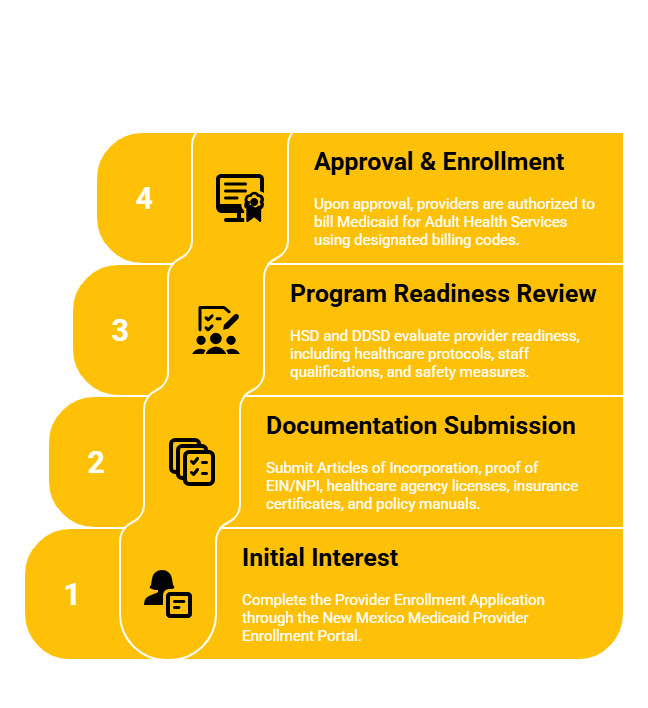
Following business formation, the agency must navigate the licensing and enrollment processes. This includes obtaining a Home Health Agency License from the NMDOH, which is a prerequisite for providing medical-based services, and maintaining comprehensive professional and general liability insurance. The administrative burden also includes the creation of a formal Policy & Procedure Manual, which must detail internal protocols for clinical care, infection control, HIPAA compliance, and grievance procedures. Once these requirements are met, the agency can submit its credentials through the New Mexico Medicaid Provider Enrollment Portal.
The Operational Roadmap: From Application to Service Launch
The trajectory from conceptualization to delivering services involves a significant investment of time and resources in administrative readiness. The process is divided into distinct phases, beginning with business formation and compliance preparation, which typically requires one to two months. During this time, founders must focus on drafting governing policies that align with state administrative codes and federal quality benchmarks.
The subsequent phases involve hiring and credentialing staff and completing the official Medicaid enrollment via the state portal. This period includes a "Program Readiness Review," during which HSD and DDSD officials evaluate the agency’s capacity to provide care. This review is a critical hurdle that requires documented proof of safety protocols, staff qualifications, and quality assurance systems. Providers should anticipate a cumulative timeline of six to twelve months to move from initial formation to the point where they are approved to bill for services under the DDSD, Mi Via, Medically Fragile, or other applicable HCBS waivers.
Staffing, Training, and Quality Assurance Standards
The clinical and operational integrity of an Adult Health Services provider rests on the caliber of its staff. The organization must be led by an Adult Health Program Director, ideally a Registered Nurse (RN) with advanced education, who oversees the clinical direction of the program. Because the agency provides medical-grade support, the staffing mix must include state-licensed RNs, Licensed Practical Nurses (LPNs), and, depending on the service scope, licensed rehabilitation specialists such as physical and occupational therapists.
Beyond initial licensing, the agency is responsible for an ongoing cycle of training and competency evaluation. All staff members must be trained in specialized chronic disease management, HIPAA regulations, and patient rights. Furthermore, the agency must maintain thorough records for every employee, including background checks and annual performance reviews, as these documents are frequently requested during state audits. Implementing a robust quality assurance system—one that monitors clinical outcomes and logs all healthcare tracking—is essential for long-term operational success.
Frequently Asked Questions
What waivers currently cover Adult Health Services in New Mexico?
Adult Health Services are provided under several Medicaid HCBS waivers, including the Developmental Disabilities (DD) Waiver, the Mi Via Waiver, the Medically Fragile Waiver, and the Supports Waiver. Each of these programs provides specific service definitions that must be followed according to the participant's individualized plan.
Is a Home Health Agency license mandatory for all providers?
Yes, if the agency intends to provide medical care, nursing services, or health-related monitoring as part of the Adult Health Services scope, a Home Health Agency license from the New Mexico Department of Health (NMDOH) is a standard requirement for legal operation.
How does an agency ensure it is ready for the Medicaid Readiness Review?
Readiness is demonstrated by having a comprehensive Policy & Procedure Manual that covers all clinical protocols, evidence of qualified staff with valid credentials and background checks, and a secure system for tracking patient health data and submitting Medicaid billings in accordance with state regulations.
Key Takeaway
Establishing an Adult Health Services provider in New Mexico is a rigorous process that demands strict adherence to state licensing, Medicaid enrollment procedures, and federal HCBS quality standards. Success depends on the agency's ability to maintain high clinical standards, hire credentialed healthcare professionals, and demonstrate ongoing compliance with the oversight of the HSD, DDSD, and NMDOH. By prioritizing a well-documented and person-centered approach, providers can successfully deliver essential health services that empower individuals to live independently.
Last verified: May 2024. This information is for educational purposes only and does not constitute legal or professional business advice. Regulations and Medicaid policies are subject to change; always consult the official New Mexico Human Services Department (HSD) and Department of Health (NMDOH) guidelines for the most current requirements.