ADULT FAMILY HOME (AFH) PROVIDER IN WASHINGTON
By Fatumata Kaba · 2026-04-06 · 5 min read
An Adult Family Home (AFH) in Washington is a licensed, residential dwelling that provides personalized, 24-hour care, room, and board for up to six adults who require assistance with activities of daily living (ADLs). As a state-regulated model, AFHs serve as an intimate, community-based alternative to larger institutional settings, allowing residents to maintain their independence while receiving essential health-related support, supervision, and companionship.
Operating an AFH requires adherence to strict regulatory standards overseen by the Department of Social and Health Services (DSHS). By becoming a licensed provider, entrepreneurs can participate in Medicaid-funded programs—including Apple Health’s Long-Term Services and Supports (LTSS)—to provide vital care for older adults and individuals with physical or intellectual disabilities.
What Are the Governing Agencies and Regulatory Requirements?
The operation of an AFH in Washington is governed by a framework of state agencies, each with a distinct role in ensuring resident safety and program integrity. Residential Care Services (RCS), a division of the DSHS, acts as the primary licensing and regulatory body, enforcing the standards set forth in WAC 388-76. Providers must maintain ongoing compliance with these administrative codes to retain their licensure and eligibility to operate.
Beyond licensing, the Aging and Long-Term Support Administration (ALTSA) manages the delivery of Medicaid-funded services for the populations served within these homes. Simultaneously, the Health Care Authority (HCA) oversees the financial administration of Medicaid reimbursements through the Apple Health system. Understanding the interplay between these agencies is critical for new providers looking to establish a sustainable and compliant business model.
How Do You Meet the Licensing and Provider Enrollment Prerequisites?
The journey to becoming an AFH provider begins with meeting fundamental eligibility criteria. Prospective providers must be at least 21 years old and pass a comprehensive DSHS background check. Following this, the candidate must complete the mandatory Adult Family Home Orientation Class and the 75-hour Adult Family Home Administrator Training. These educational requirements ensure that administrators are prepared for the operational, medical, and legal demands of running a residential care facility.
Once training is complete, the applicant must secure a physical property that meets state-mandated building and zoning requirements. The site must pass a rigorous DSHS home inspection to verify that the environment is safe and accessible. Upon obtaining a license, the provider must register with the ProviderOne portal to process Medicaid billing and contract as an LTSS provider.
- Pass a DSHS-conducted background check for all staff and owners.
- Obtain professional liability insurance and a state business license.
- Submit the formal AFH license application through the DSHS application portal.
- Complete and document the 75-hour Administrator Training program.
- Register in the ProviderOne system for Medicaid reimbursement eligibility.
What Essential Policies and Documentation Must an AFH Maintain?
Compliance in an AFH is demonstrated primarily through comprehensive documentation. A well-organized Policy and Procedure Manual is the foundation of any successful inspection. This manual must explicitly outline how the home manages daily operations, including resident admission processes, individualized assessment protocols, and clear procedures for medication administration and storage. Documentation serves as the primary evidence during DSHS site visits, confirming that the facility is operating in accordance with state law.
Safety and quality of care documentation are particularly scrutinized. Providers must maintain up-to-date logs for fire safety drills, infection control, and resident shift documentation. Furthermore, detailed records regarding nutrition—including therapeutic diet plans and meal preparation logs—are required. Maintaining accurate staff schedules, continuing education records, and client grievance forms ensures transparency and accountability in the delivery of care.
What Are the Staffing and Training Mandates?
The quality of care in an AFH is directly linked to the competency of its staff. The Administrator is responsible for ensuring that the home is covered 24/7, providing consistent supervision and hands-on assistance. All caregivers must undergo rigorous training, including state-mandated caregiver certification, background checks, and ongoing continuing education credits to stay current with evolving care standards.
Depending on the needs of the residents, the facility may also require the services of a Nurse Consultant. This is specifically relevant when the AFH provides care that involves nursing tasks requiring RN delegation. Every member of the care team must possess valid CPR/First Aid certification, as well as specialized training in dementia, mental health, and universal precautions to ensure a safe environment for all residents.
Which Medicaid Programs Support AFH Services?
AFHs play a vital role in the continuum of care by accepting Medicaid reimbursement for eligible residents. Various programs under the Apple Health LTSS umbrella allow low-income seniors and individuals with disabilities to access residential services. Key programs include the COPES Waiver, designed for those who require personal care in a residential setting, and Community First Choice (CFC), which provides personal care assistance.
In addition to these, the state offers support for specialized populations. The DDA Core Waiver provides funding for individuals with intellectual or developmental disabilities. For those who are not yet Medicaid-eligible but require support, programs such as Medicaid Alternative Care (MAC) and Tailored Supports for Older Adults (TSOA) offer pathways for assistance. Understanding which programs your facility is contracted for is essential for managing your resident census and financial stability.
Frequently Asked Questions
How long does the licensing and launch process typically take?
The timeline varies based on the speed of training completion and home readiness, but generally ranges from 4 to 12 months. This includes 1–3 months for orientation and application, 1–2 months for home inspections, and 30–60 days for ProviderOne enrollment and Medicaid contracting.
What is the role of the ProviderOne portal?
ProviderOne is the centralized system used by the Washington Health Care Authority for all Medicaid-related activities. Providers use this portal to enroll as a Medicaid provider, manage their professional credentials, submit billing claims for services rendered, and receive payments.
Can I provide care for individuals with specialized needs?
Yes, but you must ensure your staff is adequately trained and that your home is licensed to meet the specific safety and care requirements for that population. For instance, specific training in dementia or developmental disability support is often required before accepting residents with those specific diagnoses.
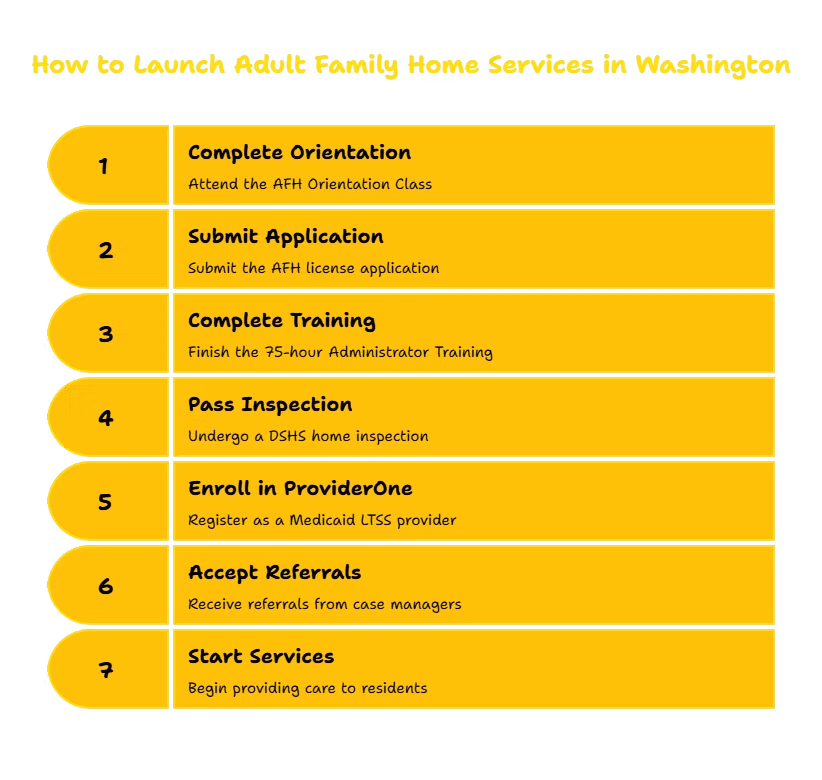
Waiver Consulting Group provides comprehensive start-up assistance for those looking to launch a compliant and successful Adult Family Home in Washington. Services include guidance on the licensing application, development of tailored Policy & Procedure Manuals, inspection preparation, and support for Medicaid enrollment through the ProviderOne system.
Key takeaway: Establishing an Adult Family Home in Washington is a multi-phase process that requires strict adherence to DSHS regulations, robust staff training, and meticulous documentation, all of which are essential for providing high-quality care and achieving long-term Medicaid contracting success.
Last verified: 2024. This content is for informational purposes only and does not constitute legal or professional advice. Always consult the latest WAC regulations and official DSHS/HCA guidance for the most current requirements.