ADULT DENTAL SERVICES PROVIDER IN TENNESSEE
By Fatumata Kaba · 2025-10-22 · 5 min read
PROMOTING ORAL HEALTH, FUNCTIONAL WELLNESS, AND QUALITY OF LIFE FOR TENNESSEE’S MEDICAID-ELIGIBLE ADULTS
Adult Dental Services in Tennessee provide essential diagnostic, preventive, and restorative oral healthcare for low-income adults enrolled in TennCare Medicaid. This includes individuals participating in Employment and Community First (ECF) CHOICES, 1915(c) Waivers, and Katie Beckett programs, with expanded coverage as of 2023 that now includes routine and emergency dental procedures to support whole-person health outcomes.
Understanding the Governing Framework for Tennessee Adult Dental Services
The provision of dental care within the Tennessee Medicaid landscape is a structured environment involving several key stakeholders. TennCare acts as the primary agency overseeing the administration of the adult dental benefit under both the State Plan and various waiver programs. Their role involves establishing clinical coverage guidelines, setting programmatic standards, and ensuring that access to care is maintained across the state.
DentaQuest serves as the TennCare Dental Benefits Administrator. Their responsibilities are comprehensive, covering the management of the provider network, the processing of claims, provider credentialing, and ongoing member education. Parallel to these entities, the Tennessee Board of Dentistry, which operates under the Department of Health, maintains regulatory authority over licensure and scope of practice. Finally, the Centers for Medicare & Medicaid Services (CMS) oversees federal compliance and the approval of necessary State Plan amendments.
What Services are Covered for Adult TennCare Enrollees?
Covered dental services for adults are defined by medical necessity and are designed to address both immediate health crises and long-term preventive needs. A primary goal of these services is to manage pain, prevent systemic health complications, and improve nutritional intake and communication abilities for individuals with complex needs. Every procedure must be clearly documented as medically necessary and be approved by a licensed dentist.
Typical covered services include:
- Preventive Care: Periodic exams, diagnostic x-rays, routine cleanings, and fluoride applications.
- Restorative Services: Fillings, crowns, and the fabrication or repair of partial and full dentures.
- Periodontal Services: Scaling, root planing, and other forms of deep cleaning to treat gum disease.
- Oral Surgery: Necessary extractions and infection drainage.
- Emergency Dental Care: Acute pain management and immediate infection control.
- Waiver-Specific Services: Dental appliances or specialized treatments as outlined in the participant's Individual Support Plan (ISP) to improve safety, nutrition, or communication.
Licensing and Provider Enrollment Requirements
Before a facility can begin serving TennCare-enrolled adults, it must meet specific administrative and clinical prerequisites. First, the dental practice must be formally registered with the Tennessee Secretary of State. Providers must also hold active, valid licenses from the Tennessee Board of Dentistry. Because compliance is non-negotiable, all entities must obtain a Type 2 National Provider Identifier (NPI) and a federal Employer Identification Number (EIN).
Beyond basic business registration, the practice must establish itself as a participating provider within the DentaQuest network. This involves rigorous credentialing where dentists, hygienists, and the organization as a whole demonstrate adherence to professional standards, including the maintenance of adequate liability and malpractice insurance. A crucial internal step is the development of an Adult Dental Services Policy & Procedure Manual, which serves as the operational blueprint for the practice's compliance with state and federal regulations.
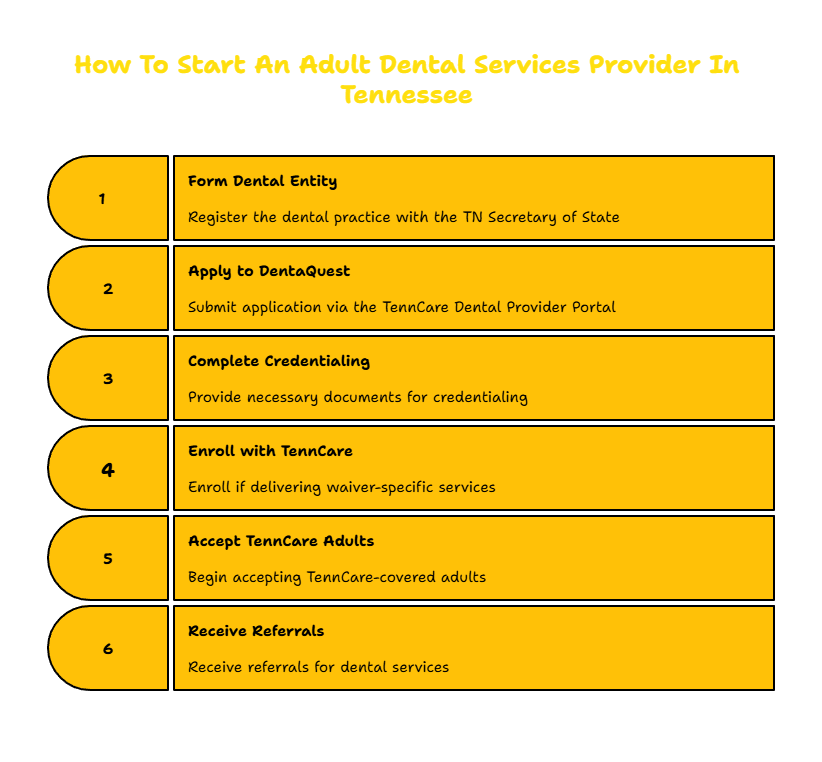
The Step-by-Step Provider Enrollment Process
The journey toward becoming an active TennCare dental provider involves a structured sequence of actions. Initially, the practice must solidify its legal and clinical foundation by obtaining the necessary business documentation and provider identification numbers. Once the organization is prepared, the primary step is submitting an application to DentaQuest through the designated TennCare Dental Provider Portal.
The credentialing phase follows, where the provider verifies all staff licenses, DEA registrations, and insurance coverage. If the practice intends to provide services specific to Medicaid waiver participants, they must also ensure they are properly enrolled in the relevant waiver provider programs. Once these administrative hurdles are cleared, the practice may begin accepting TennCare-covered adults, processing claims, and receiving referrals, ensuring that all care delivery is aligned with DentaQuest’s billing and clinical guidelines.
Staffing and Operational Standards
Operational success in an adult dental practice relies on a highly trained and compliant workforce. Every dentist must possess a current Tennessee license, a valid DEA registration, and comprehensive malpractice insurance. Dental hygienists are similarly required to hold valid state licenses and any relevant radiology certifications. Dental assistants, while performing delegated duties, must demonstrate specific expertise in OSHA guidelines, infection control, and, where applicable, radiographic procedures.
Compliance training is a mandatory component for all staff members, regardless of their role. This includes, but is not limited to, HIPAA privacy training, specialized TennCare compliance procedures, infection prevention protocols, and formal emergency response drills. Maintaining detailed records of these trainings is essential for audit preparedness and ensures that the facility consistently meets the clinical and administrative requirements expected by TennCare and DentaQuest.
Frequently Asked Questions
What documents are essential for the credentialing process?
Providers must maintain comprehensive records including, at minimum: business registration, the facility's EIN and Type 2 NPI, current Tennessee dental licenses for all practitioners, DEA registrations, and proof of professional liability insurance. Additionally, the practice must have a fully developed Policy & Procedure Manual that covers intake, emergency protocols, HIPAA compliance, and billing procedures.
How do waiver programs like ECF CHOICES affect dental coverage?
Under programs such as ECF CHOICES and 1915(c) Waivers, dental services are often tailored to address specific needs identified in the participant’s Individual Support Plan. This may include services that improve nutritional status, communication capabilities, or overall health outcomes beyond what is provided under the standard adult dental benefit.
What is the typical timeline for launching a practice in this sector?
The launch process generally spans several months, with 1–2 months allocated to business formation and licensing, followed by 2–3 months for DentaQuest credentialing and TennCare enrollment. An additional 30–60 days should be reserved for internal staff training and the configuration of clinical systems, allowing the practice to be fully prepared to handle claims and patient scheduling upon approval.
Key Takeaway
Establishing an adult dental practice in Tennessee requires a rigorous commitment to administrative compliance, clinical excellence, and systematic adherence to TennCare and DentaQuest requirements. By thoroughly documenting policies, ensuring staff are appropriately credentialed, and focusing on the specific needs of Medicaid and waiver-eligible populations, providers can successfully deliver critical oral healthcare that significantly enhances the quality of life for TennCare enrollees.
Last verified: 2024. The information provided here is for general informational purposes only and does not constitute legal or professional advice. Readers should consult with official Tennessee state resources and the Centers for Medicare & Medicaid Services (CMS) for the most current regulations and program requirements.