ADULT DAY SERVICES PROVIDER IN SOUTH DAKOTA
By Fatumata Kaba · 2025-10-15 · 6 min read
Adult Day Services (ADS) in South Dakota function as critical community-based hubs that provide structured programming, health monitoring, and social engagement for adults with cognitive or physical impairments. By operating under the South Dakota Medicaid Home and Community-Based Services (HCBS) framework—primarily through the HOPE Waiver—these providers play a vital role in preventing premature institutionalization while offering essential respite for family caregivers.
Establishing an adult day service program requires strict adherence to state-mandated licensure standards and Medicaid provider enrollment protocols. This guide outlines the essential regulatory, operational, and administrative steps for organizations seeking to become approved providers within the South Dakota long-term services and supports system.
What Are the Governing Agencies and Regulatory Frameworks?
Operating an adult day center in South Dakota involves navigating a multi-agency regulatory environment. Each agency plays a distinct role in ensuring that providers maintain high standards of care, financial integrity, and participant safety. Understanding these relationships is the first step in successful program administration.
The South Dakota Department of Human Services (DHS), specifically the Division of Long-Term Services and Supports (LTSS), serves as the primary entity overseeing program standards and participant assessments. Simultaneously, the South Dakota Department of Social Services (DSS), through the Medical Services Division, manages the financial aspect of the program, including Medicaid provider enrollment, claims processing, and reimbursement.
Operational safety is governed by the Department of Health – Office of Health Protection, which manages the facility licensing process. Finally, local Case Management Agencies act as the frontline for service coordination, conducting the necessary needs assessments and authorizing the specific services that appear in a participant’s Individualized Care Plan (ICP).
- Department of Human Services (DHS) – LTSS: Oversees program administration and service standards.
- Department of Social Services (DSS) – Medical Services: Manages enrollment, billing, and payments.
- Department of Health – Office of Health Protection: Issues operational licenses and performs safety inspections.
- Local Case Management Agencies: Authorize care plans and manage participant eligibility.
How Do You Structure Core Adult Day Services?
Adult day services must be designed as person-centered, non-residential programs that prioritize the health and socialization of the participant. To meet Medicaid requirements, services must be tied directly to the needs outlined in the participant's ICP, ensuring that the structured environment actively contributes to their stability in the community.
Core programming typically includes robust supervision and safety monitoring, structured recreational and educational activities, and personal care assistance. Many centers also incorporate health monitoring, medication reminders or administration by licensed professionals, and nutritional support that accommodates individual dietary restrictions.
When developing the program schedule, providers should prioritize cognitive stimulation for participants with memory-related needs, alongside frequent caregiver updates. Because these services are funded as an HCBS benefit, every activity must be documented to demonstrate that it serves a clear purpose, such as maintaining functional independence or improving the participant's quality of life.
- Structured daily programming and recreational activities.
- Personal care assistance, including grooming and toileting.
- Professional health monitoring and medication management.
- Nutritional support and meal services.
- Transportation options to and from the center.
What Are the Essential Licensing and Enrollment Requirements?
The path to becoming a Medicaid-approved provider requires a sequential approach to legal and operational compliance. Organizations must first establish their business entity with the South Dakota Secretary of State and secure a Federal EIN and Type 2 NPI. Without these foundational business elements, Medicaid enrollment cannot proceed.
Following business registration, the facility must obtain the required Adult Day Services license through the Department of Health. Once licensed, the entity must formally enroll with South Dakota Medicaid under the HOPE Waiver. This process necessitates the creation of a comprehensive Policy & Procedure (P&P) Manual, which serves as the primary document for regulatory audits.
Providers must also ensure their physical facility meets Americans with Disabilities Act (ADA) compliance, along with state-specific safety and sanitation standards. Furthermore, maintaining appropriate insurance coverage—including liability and workers’ compensation—is a mandatory prerequisite for maintaining active provider status.
- Business registration and federal tax identification.
- Department of Health facility licensure.
- Medicaid provider enrollment via the HOPE Waiver.
- Development of a comprehensive Policy & Procedure Manual.
- ADA-compliant facility and adequate insurance coverage.
What Documentation Is Required for Operational Compliance?
Maintaining a high level of administrative organization is necessary to pass state inspections and Medicaid audits. Your P&P Manual should function as a living document that guides staff on daily operations and emergency preparedness. It must clearly define the intake process, how care plans are implemented, and how incident reporting is conducted.
Beyond the policy manual, providers must maintain rigorous records regarding staff credentials and participant progress. This includes keeping documented proof of background checks, CPR/First Aid certifications, and ongoing training hours for all personnel. HIPAA compliance documentation must be strictly enforced, ensuring all patient health information is protected in both physical and digital formats.
Infection control and sanitation procedures are also critical components of the required documentation. Providers should keep updated logs of cleaning schedules, dietary records (including any special diets administered), and medication administration records (MARs) to ensure full accountability in the event of a review by state officials.
How Do You Manage Staffing and Training?
Staffing requirements are centered on the necessity of providing safe, high-quality care. A Program Director is required to oversee the daily functions of the center, ensuring compliance with state regulations and managing staff training. This role typically requires experience in nursing, gerontology, or social services.
Direct care staff and activity assistants must be at least 18 years of age and hold a high school diploma or equivalent. Each individual must undergo a comprehensive background check and abuse registry clearance. If the center provides skilled tasks, such as medication administration, a Licensed Practical Nurse (LPN) or Registered Nurse (RN) must be on staff or available to provide oversight.
All personnel are required to complete standardized training on HIPAA compliance, the prevention of abuse and neglect, and emergency preparedness. Because ADS settings are highly interactive, training should also focus on effective activity planning and compassionate personal care techniques to ensure that all participants receive a consistent level of support.
Frequently Asked Questions
Is transportation to and from the adult day center always covered?
Transportation coverage depends on the individual participant's authorized services as specified in their Individualized Care Plan (ICP). Providers should verify authorization through the participant’s case manager before assuming transport costs.
What is the typical timeline to launch a new adult day service center?
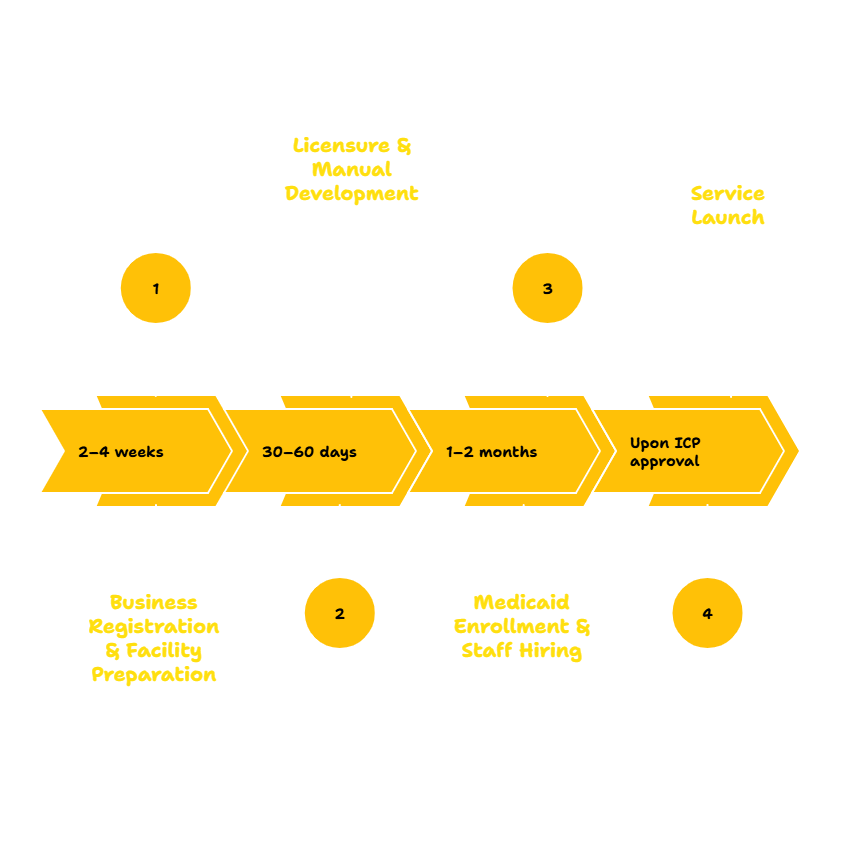
The timeline typically ranges from three to six months. This includes 2–4 weeks for business registration, 30–60 days for licensure, and 1–2 months for Medicaid enrollment and staff onboarding.
Can veterans access adult day services through non-Medicaid sources?
Yes, veterans may be eligible for adult day services through the Department of Veterans Affairs (VA) or other private payer sources, which may operate independently of the state Medicaid HOPE Waiver requirements.
Key Takeaway: Successful participation in South Dakota’s Medicaid-funded adult day service system relies on maintaining a seamless integration between state-mandated licensing, rigorous internal policy development, and a strong commitment to person-centered care. Providers who prioritize administrative compliance and staff training will be best positioned to meet the evolving needs of the aging and disabled population in their communities.
Last verified: September 2023. Disclaimer: This document is for informational purposes only and does not constitute legal or financial advice. Regulations governing Medicaid waiver programs are subject to change. Always consult with the South Dakota Department of Human Services or appropriate legal counsel to ensure your organization is in compliance with current state and federal statutes.