ADULT DAY SERVICES PROVIDER IN MINNESOTA
By Fatumata Kaba · 2025-07-27 · 5 min read
PROVIDING SUPPORT AND SOCIAL ENGAGEMENT FOR ADULTS WITH DISABILITIES AND THE ELDERLY
Adult Day Services in Minnesota offer structured care, clinical oversight, and social interaction for adults who require supervision during daytime hours. By providing a safe, engaging environment, these centers support individuals with disabilities, chronic health conditions, or age-related challenges to remain within their communities while receiving necessary support under Minnesota’s Home and Community-Based Services (HCBS) Waivers.
Understanding the Regulatory Landscape for Minnesota Adult Day Services
Operating an Adult Day Service center in Minnesota requires navigating a multi-layered regulatory environment. The Minnesota Department of Human Services (DHS) serves as the primary administrator for Medicaid programs, overseeing the HCBS Waivers that fund these services. Because these services are Medicaid-funded, providers must ensure their operational models align with strict state and federal mandates regarding service delivery, participant rights, and billing compliance.
The Minnesota Department of Health (MDH) holds authority over the physical licensing and regulatory standards of centers. This includes ensuring the environment meets safety codes and that care delivery adheres to state health standards. Simultaneously, the Centers for Medicare & Medicaid Services (CMS) provides the overarching federal framework, ensuring that all state-level waiver services comply with federal quality and accessibility requirements.
- Minnesota Department of Human Services (DHS): Administers Medicaid programs and HCBS Waivers.
- Minnesota Department of Health (MDH): Licenses and regulates adult day service centers.
- Centers for Medicare & Medicaid Services (CMS): Provides federal oversight and ensures waiver compliance.
Core Components of Adult Day Service Programs
Adult Day Services are fundamentally designed to replace the isolation of homebound living with structured, meaningful daytime engagement. Each service plan is deeply individualized, guided by a participant’s Person-Centered Plan (PCP) or Individual Service Plan (ISP). These plans ensure that the care provided reflects the specific medical, social, and emotional needs of the participant.
Daily operations typically include a blend of health monitoring and recreational programming. This may involve medication management by qualified staff, nutritious meal provision, and personal care assistance such as grooming or mobility support. By integrating these services into a daytime schedule, providers create a support system that not only maintains the participant’s health but also offers respite for primary caregivers.
- Social and recreational activities designed to foster community engagement.
- Personal care assistance, including help with grooming and hygiene.
- Health monitoring, medication reminders, and vital sign checks.
- Nutritious meals and snacks tailored to dietary requirements.
- Physical and cognitive stimulation activities to maintain functional status.
- Transportation services to and from the center.
Navigating the Provider Enrollment and Licensing Process
To become a recognized Medicaid provider, an agency must follow a rigorous, sequential path. The process begins with establishing the legal business entity through the Minnesota Secretary of State, followed by obtaining an Employer Identification Number (EIN) from the IRS and a Type 2 National Provider Identifier (NPI). These are the fundamental business credentials required to engage with state and federal healthcare systems.
Once the business is legally established, the provider must obtain an Adult Day Services License from the MDH. After licensure, the agency must initiate the Medicaid provider enrollment process with the Minnesota DHS. This involves submitting comprehensive documentation, including proof of liability insurance and detailed service descriptions. Successful enrollment concludes with the assignment of a Medicaid provider number, which authorizes the center to bill for services rendered to waiver participants.
- Register the business with the Minnesota Secretary of State.
- Obtain an IRS EIN and a Type 2 NPI.
- Secure an Adult Day Services License from the Minnesota Department of Health.
- Complete the Medicaid provider enrollment application with the Minnesota DHS.
- Maintain comprehensive liability insurance and detailed staff qualification records.
Establishing Standards for Staffing and Training
The quality of an Adult Day Service program is directly tied to the competency and dedication of its staff. The Adult Day Program Director plays a pivotal role in operational success, necessitating a background in social work, healthcare administration, or an equivalent professional field. This role requires oversight of both the administrative requirements and the clinical standards of care provided to participants.
Direct support staff are the primary point of contact for participants and must meet specific baseline requirements. Each team member must hold at least a high school diploma or equivalent, possess current CPR/First Aid certification, and undergo thorough background checks and TB clearance. Ongoing training is mandatory and must cover safety, emergency response, person-centered care philosophy, and precise documentation techniques.
- Program Director: Must have experience in social work or healthcare administration.
- Direct Support Worker: Must hold a high school diploma and CPR/First Aid certification.
- Mandatory Training Topics: Safety, client rights, health monitoring, and documentation.
Overview of Applicable Medicaid Waivers
Adult Day Services are funded through specific 1915(c) HCBS Waiver programs designed to support long-term care needs. Understanding which waiver a participant utilizes is essential for verifying service authorization and billing correctly. These waivers are designed to provide the necessary support to keep individuals in their home and community, rather than in an institutional setting.
The three primary waivers facilitating these services in Minnesota include the Elderly and Disabled Waiver, the Community Access for Disability Inclusion (CADI) Waiver, and the Brain Injury (BI) Waiver. Each of these programs provides a financial pathway for providers to deliver daytime supervision, health monitoring, and personal care services to eligible populations.
- 1915(c) HCBS Waiver for the Elderly and Disabled.
- Community Access for Disability Inclusion (CADI) Waiver.
- Brain Injury (BI) Waiver.
Frequently Asked Questions
How long does the provider enrollment process typically take?
While timelines can vary based on the completeness of the initial application, the Medicaid provider enrollment phase generally takes between 60 and 90 days. Additional time should be factored in for business formation, facility licensing, and staff recruitment.
What are the primary documentation requirements for a new provider?
New providers must maintain rigorous documentation, including articles of incorporation, EIN and NPI confirmation, proof of liability insurance, and the facility’s operating license. Furthermore, a comprehensive policy and procedure manual covering intake, safety, and staff training is essential for compliance audits.
What is the role of a Person-Centered Plan (PCP) in daily service delivery?
The PCP acts as the blueprint for an individual’s care. It outlines specific goals, health needs, and preferences. Every service provided, from social activities to health monitoring, must align with the objectives stated in the participant's PCP to ensure compliance with Medicaid funding requirements.
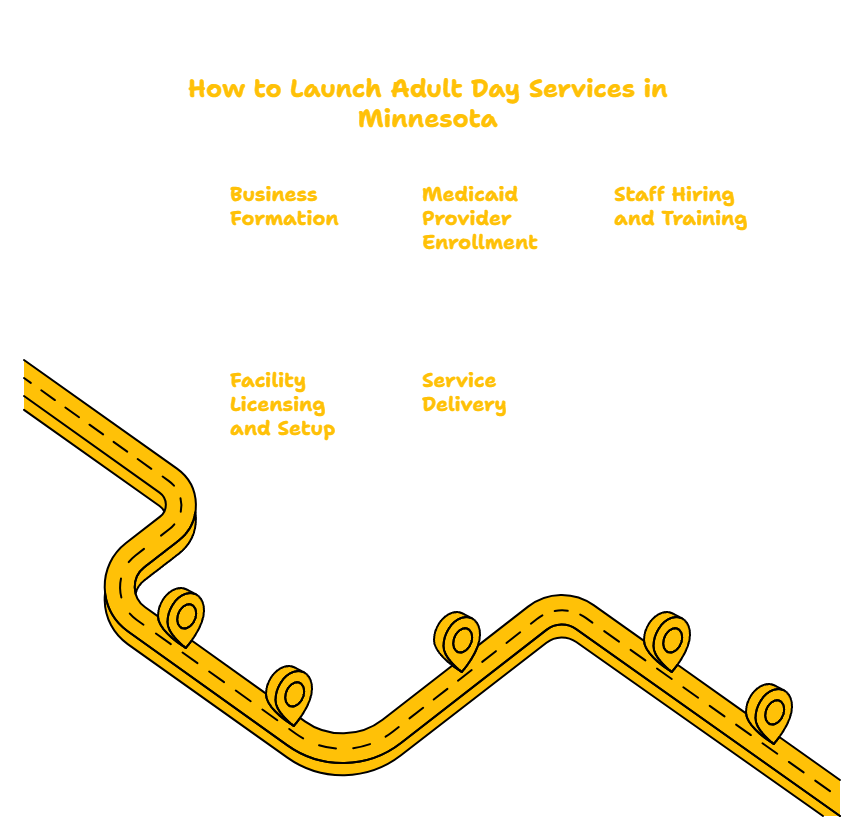
Key Takeaway: Successfully launching an Adult Day Service provider agency in Minnesota requires a methodical approach that balances rigorous state-mandated licensing, federal Medicaid compliance, and a strong commitment to person-centered care models. Founders must prioritize early engagement with the Minnesota Department of Human Services and the Minnesota Department of Health to ensure all regulatory, staffing, and documentation standards are met before accepting participants.
Last verified: October 2023. Disclaimer: This information is for educational purposes only and does not constitute legal or professional advice. Requirements for Medicaid provider enrollment and state licensing can change. Please consult with the Minnesota Department of Human Services and the Minnesota Department of Health directly for the most current regulations and application procedures.