BEHAVIORAL HEALTH SERVICES PROVIDER IN MASSACHUSETTS
By Fatumata Kaba · 2025-08-08 · 5 min read
DELIVERING INDIVIDUALIZED MENTAL HEALTH AND SUBSTANCE USE SUPPORT ACROSS HOME, COMMUNITY, AND OUTPATIENT SETTINGS
Behavioral Health Services in Massachusetts represent a critical infrastructure for fostering mental wellness, recovery, and autonomy among individuals navigating mental illness, emotional disturbances, or substance use disorders. These services are delivered through a multifaceted system involving MassHealth’s Behavioral Health Initiative, various managed care plans, and specialized Home and Community-Based Services (HCBS) programs, all designed to ensure that care is accessible in the environments where members live and thrive.
Understanding the Governing Agency Landscape
The regulatory framework for behavioral health in Massachusetts is centralized under the Executive Office of Health and Human Services (EOHHS), which dictates state-wide policy and manages the MassHealth program. EOHHS sets the foundational requirements for service delivery, eligibility, and reimbursement rates, ensuring that the state's healthcare objectives align with broader federal standards.
Operational oversight is distributed among several key entities that maintain the integrity of the service delivery system. The Massachusetts Behavioral Health Partnership (MBHP) and other Managed Care Organizations (MCOs), such as Tufts Health Together and BMC HealthNet Plan, act as the primary administrators of services for Medicaid-eligible members. Furthermore, the Department of Mental Health (DMH) provides essential licensing and coordination for individuals living with serious mental illness, while the Centers for Medicare & Medicaid Services (CMS) maintains ultimate authority over the approval and oversight of 1915(c) waiver programs and federal Medicaid funding.
Categorizing Behavioral Health Service Delivery Models
Behavioral health services in the Commonwealth are tiered to support individuals across a wide spectrum of acuity, ranging from preventative, short-term counseling to intensive, long-term clinical interventions. By integrating these services into the community, providers can effectively address the holistic needs of their clients, preventing hospitalizations and promoting long-term stability.
Commonly authorized service types include:
- Outpatient therapy, encompassing individual, group, or family counseling sessions.
- In-home therapy and therapeutic mentoring, primarily directed toward youth populations.
- Peer support services and recovery coaching facilitated by individuals with lived experience.
- Mobile crisis intervention teams capable of immediate response.
- Intensive Care Coordination (ICC) for complex case management.
- Psychiatric consultation and ongoing medication management.
- Community Support Programs (CSP) tailored for adults with complex, chronic needs.
Navigating Licensing and Operational Prerequisites
Launching a behavioral health practice requires rigorous adherence to state and federal mandates. Before a provider can begin billing, they must solidify their business entity, starting with registration through the Massachusetts Secretary of the Commonwealth. This legal foundation must be supported by a federal Employer Identification Number (EIN) and a Type 2 National Provider Identifier (NPI), both of which are essential for tracking claims and regulatory reporting.
Beyond administrative setup, clinical providers must secure appropriate professional liability insurance and obtain necessary site-based licenses. Depending on the service scope, this may involve direct interaction with the DMH, the Department of Children and Families (DCF), or the Department of Public Health (DPH). Furthermore, providers must maintain a robust set of HIPAA-compliant Policies and Procedures, ensuring that all clinical documentation, treatment plans, and incident reporting protocols meet the stringent requirements of both the state and the relevant auditing agencies.
The Provider Enrollment and Credentialing Process
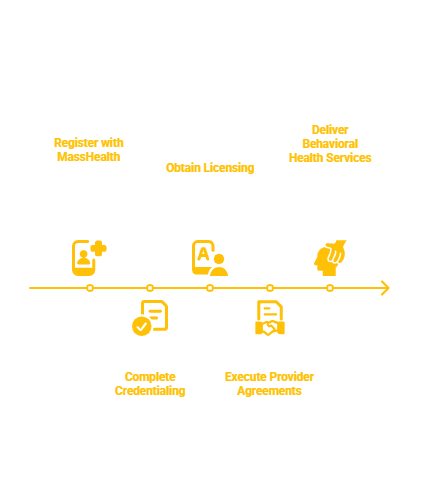
The transition from a business entity to a qualified Medicaid provider involves a structured, multi-step enrollment sequence. Initial registration takes place via the MassHealth Provider Online Service Center (POSC), which acts as the primary portal for program entry. Once registered with MassHealth, providers must move to the credentialing phase, which involves submitting detailed documentation, clinician rosters, and service scope descriptions to MBHP and participating MCOs to ensure network participation and reimbursement eligibility.
For those establishing site-based clinics, the process includes the critical step of obtaining a DMH site license or a DPH clinic license specifically for substance use services. Throughout this period, agency founders must ensure that all provider agreements are executed, compliance manuals are operationalized, and the supervisory infrastructure is prepared for immediate deployment upon approval. Failure to align these components before the launch date often leads to significant administrative delays in the billing cycle.
Establishing Essential Documentation and Staffing Standards
The integrity of a behavioral health agency rests on its documentation and human capital. A comprehensive Policy & Procedure Manual must be in place, containing standardized templates for intake, screening, referrals, progress notes, and discharge summaries. This manual must also outline clear protocols for medication administration, incident reporting, and the handling of client rights and informed consent, ensuring that the agency remains audit-ready at all times.
Staffing requirements are equally specific, predicated on the clinician’s level of licensure and the nature of the service. Licensed professionals such as LICSWs, LMHCs, LMFTs, Psychologists, or Psychiatrists must hold valid Massachusetts licenses and carry their own professional liability coverage. Unlicensed behavioral health workers are required to hold a bachelor's degree in a related field and operate under the direct, documented supervision of a licensed clinician. Additionally, all staff—including Peer Support and Recovery Coaches—must complete mandatory training modules, covering HIPAA compliance, trauma-informed care, emergency crisis response, cultural competency, and ethical boundaries.
Frequently Asked Questions
What is the primary portal for MassHealth enrollment?
All provider enrollment requests must be submitted through the MassHealth Provider Online Service Center (POSC) at https://massgov.account.gov.
How does a provider gain access to the Managed Care network?
After completing MassHealth enrollment, providers must separately complete credentialing with individual MCOs such as MBHP, which involves submitting clinician rosters and demonstrating adherence to specific program quality standards.
What is the difference between DMH and DPH licensing?
DMH licensing is primarily concerned with the oversight of services for individuals with serious mental illness, whereas DPH licensing is frequently required for clinics focusing on substance use and specific outpatient medical or mental health procedures.
Waiver Consulting Group’s Start-up Assistance Service
WCG assists licensed professionals, community clinics, and non-profits in navigating the complexities of launching Medicaid-approved behavioral health practices across Massachusetts. Our scope of work includes business and MassHealth registration, licensing support, development of comprehensive Policy & Procedure Manuals, MCO credentialing, and the establishment of staff onboarding and clinical supervision logs. We also provide guidance on service documentation, billing tools, compliance checklists, and referral network support, ensuring agencies are prepared to integrate seamlessly with CBHI, CSP, and DMH service teams.
Key takeaway: Success in the Massachusetts behavioral health market requires the careful synchronization of state licensure, managed care credentialing, and robust clinical documentation practices, all anchored by a strict adherence to EOHHS and DMH regulatory guidelines.
Last verified: October 2023. Disclaimer: This article is intended for informational purposes only and does not constitute legal or professional consulting advice. Regulations are subject to change; always verify requirements with the MassHealth Provider Enrollment portal and relevant state agencies before making business decisions.