ADULT DAY CARE SERVICES PROVIDER IN NEVADA
By Fatumata Kaba · 2025-09-04 · 6 min read
Adult Day Care Services in Nevada provide essential, structured, and supervised daytime environments for adults living with disabilities, chronic health conditions, or age-related challenges. As a core component of the state’s Home and Community-Based Services (HCBS) framework, these programs foster social engagement, promote health monitoring, and offer critical respite for primary caregivers, all while supporting participant independence within the community.
What Is the Role of Nevada’s Governing Agencies in Adult Day Care Oversight?
The delivery of Adult Day Care services in Nevada is governed by a multi-tiered regulatory framework designed to ensure participant safety and the responsible use of public funds. At the state level, the Nevada Department of Health and Human Services (DHHS) serves as the primary administrator, managing Medicaid waiver funding, overseeing provider enrollment, and coordinating service authorization and reimbursement. Working in tandem, the Aging and Disability Services Division (ADSD) is responsible for ensuring that all providers meet state-mandated quality standards and adhere to strict service delivery protocols.
On a federal level, the Centers for Medicare & Medicaid Services (CMS) provides necessary oversight to ensure that Nevada’s Medicaid-funded programs remain compliant with national standards. These standards emphasize person-centered planning, participant rights, and protection protocols. By aligning state policies with federal expectations, these agencies create a robust infrastructure that allows Adult Day Care providers to deliver high-quality, reliable services to some of Nevada’s most vulnerable populations.
How Do Adult Day Care Providers Support Participant Well-Being?
Adult Day Care services are specifically designed to bridge the gap between home-based care and institutionalized living by providing comprehensive daytime support. When a primary caregiver requires time to work or attend to personal matters, these centers offer a secure environment where participants receive individualized attention. These services are not one-size-fits-all; they are strictly delivered according to a participant’s Individualized Service Plan (ISP) to address their unique medical and social requirements.
Beyond basic supervision, approved providers deliver a diverse range of activities and support services, including:
- Social and Recreational Activities: Facilitated group exercises, cognitive games, creative crafts, and supervised community outings.
- Health Monitoring: Regular vital sign checks, organized medication reminders, and ongoing wellness assessments.
- Personal Care Assistance: Compassionate support with Activities of Daily Living (ADLs) such as grooming, toileting, and mobility assistance.
- Nutritional Support: Provision of balanced meals and snacks that accommodate specific dietary requirements or medical restrictions.
- Therapeutic Support: Access to physical, occupational, and cognitive therapies designed to maintain or improve current functional levels.
What Are the Essential Requirements for Licensing and Provider Approval?
Launching an Adult Day Care facility in Nevada is a rigorous process that demands strict adherence to administrative and operational requirements. Before a provider can apply for Medicaid reimbursement, they must establish a formal business entity with the Nevada Secretary of State and secure all necessary business licenses. Furthermore, prospective providers must obtain an Employer Identification Number (EIN) from the IRS and a Type 2 National Provider Identifier (NPI) to facilitate professional billing.
Once the legal foundation is set, the provider must demonstrate operational readiness. This includes obtaining an Adult Day Care Facility License from the DHHS where applicable, and securing both general and professional liability insurance. Equally important is the development of a comprehensive policy and procedure manual. This document must explicitly detail how the agency will manage participant intake, handle health emergencies, maintain staff training records, and ensure ongoing compliance with HIPAA and participant safety standards.
How Should Providers Navigate the Nevada Medicaid Enrollment Process?
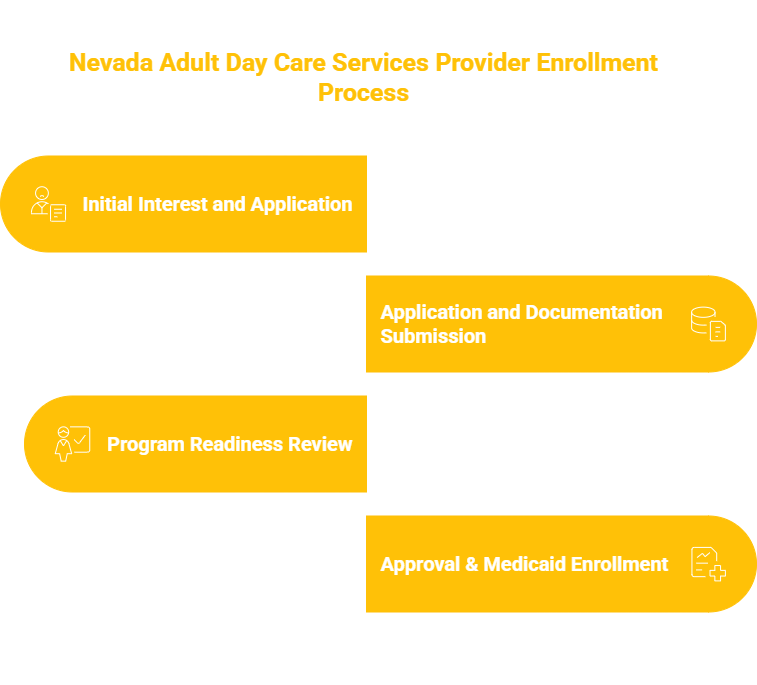
The path to becoming a Medicaid-enrolled provider involves a structured sequence of applications and reviews. The process begins by submitting an application through the Nevada Medicaid Provider Enrollment Portal specifically for Adult Day Care Services under the relevant HCBS waivers. Applicants are required to provide extensive documentation, including articles of incorporation, proof of insurance, detailed staff qualifications, and comprehensive internal policy manuals.
After the initial application, the DHHS and ADSD conduct a program readiness review. This evaluation is designed to confirm that the provider has the necessary systems in place to deliver care safely and effectively. Once the state verifies that the agency meets all training, protocol, and safety requirements, the provider is officially authorized to bill Medicaid for services. Successful enrollment concludes with the issuance of authorization to use specific Medicaid billing codes, marking the agency’s transition into active service delivery.
What Documentation Is Required for Sustained Compliance?
Maintaining a successful Adult Day Care agency requires meticulous record-keeping and an unwavering commitment to administrative accuracy. Providers must maintain a centralized, updated Policy & Procedure Manual that serves as the blueprint for daily operations. This manual should cover essential domains such as participant assessment, activity planning, staff credentialing, and ongoing competency evaluations. It must also incorporate clear protocols for handling grievances, protecting client rights, and managing sensitive health information under HIPAA guidelines.
In addition to foundational business documents like the NPI and business licenses, providers must keep detailed records of:
- Attendance and service logs used for Medicaid billing validation.
- Background check results and health screening records for every staff member.
- Individualized Service Plans (ISPs) for each participant.
- Documentation of regular safety drills, infection control procedures, and emergency response training.
- Quality assurance reports used to track participant outcomes and agency performance.
What Are the Staffing and Training Expectations?
The quality of an Adult Day Care program depends heavily on the competence and compassion of its staff. The Program Director must typically hold a bachelor’s degree in social work, healthcare administration, or a related field, along with prior experience in managing similar care settings. This leadership role is responsible for ensuring that all direct care workers, activity coordinators, and healthcare professionals remain in compliance with both state regulations and the agency’s internal policies.
Every team member must undergo rigorous training to ensure a safe and supportive environment. This includes, but is not limited to, certification in CPR and First Aid, as well as specialized training in person-centered care and the facilitation of therapeutic group activities. Ongoing professional development is a mandatory aspect of the role, with staff expected to participate in annual competency evaluations to maintain their qualifications and remain current on best practices in healthcare and social engagement.
How Does the Waiver Program Structure Support Participant Access?
Adult Day Care services are integrated into several key Nevada Medicaid waivers, which serve as the funding mechanism for participants who meet the necessary level of care. These waivers are specifically tailored to different populations, ensuring that services are accessible to those who need them most. The primary programs include the Home and Community-Based Waiver for Persons with Intellectual and Developmental Disabilities (HCBS-IDD), the Frail Elderly (FE) Waiver, the Physical Disabilities Waiver, the Traumatic Brain Injury (TBI) Waiver, and the Aged and Disabled (AD) Waiver.
By operating under these waivers, providers are able to offer a comprehensive suite of services that help participants remain in their own homes and communities. These waivers allow for flexible support, ranging from group-based recreational activities that prevent social isolation to more intensive health monitoring and rehabilitative exercises. The inclusion of these services in the Medicaid HCBS framework reflects a state-wide commitment to community-based care and the enhancement of the quality of life for all participants.
Frequently Asked Questions
What is the typical timeline for launching an Adult Day Care agency?
The launch process generally spans 6 to 9 months. This includes 1–2 months for business formation, 2–3 months for staffing and program development, 60–90 days for Medicaid enrollment and readiness reviews, and finally 30–45 days for system testing and service initiation.
Are there specific insurance requirements for these providers?
Yes, providers must maintain both general liability and professional liability insurance. These policies ensure that the agency is protected against potential risks and demonstrates to the state that they are financially and operationally prepared to manage client care.
How does the Waiver Consulting Group assist with the launch process?
Waiver Consulting Group provides end-to-end support, including business registration, Medicaid enrollment assistance, policy manual development, staff training templates, and guidance on audit-prepared financial management to ensure agencies are fully compliant with Nevada’s regulatory standards.
Key Takeaway: Establishing a successful Adult Day Care agency in Nevada requires a balance of rigorous administrative compliance, adherence to Medicaid-specific waiver requirements, and a dedicated focus on person-centered programming. By carefully navigating the registration, enrollment, and staff training phases, providers can establish sustainable, high-quality programs that meet the vital needs of Nevada’s aging and disabled populations.
Last verified: 2024. This content is for informational purposes only and does not constitute legal or financial advice. Consult directly with the Nevada Department of Health and Human Services (DHHS) or a qualified consultant for the most current regulatory requirements.