ADAPTIVE EQUIPMENT SERVICES PROVIDER IN WISCONSIN
By Fatumata Kaba · 2026-04-14 · 5 min read
Adaptive Equipment Services in Wisconsin provide critical support to children and adults with disabilities by delivering personalized medical and assistive devices that enhance functional independence in home and community settings. These services encompass the professional assessment, selection, acquisition, and maintenance of equipment—ranging from simple daily living aids to sophisticated mobility and communication systems—that are essential for managing health, safety, and autonomy. Funding for these services is facilitated through various Wisconsin Medicaid programs, including the State Plan and Home and Community-Based Services (HCBS) waivers such as IRIS, Family Care, Children’s Long-Term Support (CLTS), and the Children’s Community Options Program (CCOP).
Understanding the Governing Landscape and Regulatory Oversight
The provision of adaptive equipment in Wisconsin is regulated by the Department of Health Services (DHS), which establishes the foundational policy framework for durable medical equipment (DME) and assistive technology. Providers must navigate a structured system where ForwardHealth serves as the primary gateway for Medicaid provider enrollment, claims processing, and the critical prior authorization process for medically necessary items. Understanding these regulatory requirements is the first step for any agency aiming to offer compliant services within the state.
Beyond state-level Medicaid oversight, service delivery is managed locally by Managed Care Organizations (MCOs) and IRIS Consultant Agencies (ICAs). These entities are responsible for reviewing and authorizing equipment requests as part of a participant’s Individual Service Plan (ISP) or Support and Service Plan (SSP). Establishing strong relationships and clear communication channels with these local agencies is essential for ensuring that equipment requests are properly documented and aligned with the participant’s functional goals and budgetary requirements.
Identifying Covered Equipment and Clinical Justification Standards
Adaptive equipment providers must supply a diverse array of devices tailored to individual functional requirements. To qualify for funding, all equipment must be deemed medically necessary, supported by robust clinical documentation, and explicitly integrated into the participant’s approved care plan. Providers are responsible for not only sourcing high-quality products but also ensuring they meet the specific needs defined by the participant's healthcare team.
Common categories of covered adaptive equipment and services include:
- Mobility aids, such as manual and powered wheelchairs and adaptive strollers.
- Support equipment, including hospital beds, mechanical lifts, and specialized transfer devices.
- Augmentative and Alternative Communication (AAC) devices for individuals with speech or cognitive impairments.
- Custom-fitted items such as orthotics, prosthetics, braces, and specialized helmets.
- Environmental and sensory aids, including voice-activated controls, modified utensils, and visual or hearing assistance tools.
- Positioning equipment designed to prevent complications and improve daily function.
Navigating the Provider Enrollment and Qualification Process
Launching an adaptive equipment service requires a rigorous approach to administrative compliance. Prospective providers must first register their business entity with the Wisconsin Department of Financial Institutions (DFI) and secure a federal Employer Identification Number (EIN) and a Type 2 National Provider Identifier (NPI). This foundational step ensures the agency is legally recognized and prepared for the credentialing requirements set forth by state and federal health programs.
Following business registration, the provider must enroll as a DME provider with ForwardHealth to facilitate Medicaid billing. Simultaneously, the provider should pursue enrollment within specific MCO and ICA networks to serve waiver-eligible participants. The application process requires the submission of comprehensive documentation, including detailed product catalogs, established evaluation protocols, and clear safety policies. Success in this phase is contingent upon demonstrating the agency’s ability to conduct professional assessments and provide ongoing follow-up support.
Establishing Standardized Policies and Staffing Protocols
A comprehensive Policy and Procedure (P&P) Manual is the cornerstone of a compliant adaptive equipment service. This manual must detail every aspect of the service delivery cycle, from the initial clinical evaluation and device fitting to long-term maintenance and replacement policies. Furthermore, the manual must outline strict adherence to HIPAA guidelines, infection control practices, and manufacturer warranty tracking to ensure service quality and participant safety.
Staffing requirements are equally critical, as they dictate the quality of care provided to participants. Agencies must employ or contract with licensed professionals—such as Occupational Therapists (OT), Physical Therapists (PT), Speech-Language Pathologists (SLP), or certified Assistive Technology Professionals (ATP)—to conduct evaluations and provide training on complex devices. In addition to technical certifications, all staff members must undergo thorough training in documentation standards, equipment safety, and confidentiality protocols to maintain compliance with state regulations.
Implementing Successful Service Delivery Workflows
The lifecycle of an adaptive equipment service request involves a standardized workflow that ensures accountability and clinical efficacy. Once a referral is received, the agency must coordinate with the participant and their care team to complete a formal assessment. This clinical justification is then submitted for prior authorization, providing the necessary evidence that the equipment is essential for the participant's health and independence. Once approved, the provider facilitates the delivery, custom fitting, and necessary training to ensure the participant can safely utilize the device.
Following delivery, the agency is responsible for ongoing support, including maintenance schedules and repair logs. This level of service ensures that equipment remains functional over time and provides a record of use that may be required for future audits or replacement requests. By maintaining rigorous documentation and clear communication with MCOs and ICAs, providers establish a reliable reputation within the Wisconsin HCBS community.
Frequently Asked Questions
What is the primary role of ForwardHealth in adaptive equipment services?
ForwardHealth serves as the central administrative body for Wisconsin Medicaid. It handles the official provider enrollment process, manages claims submissions for Medicaid-reimbursed items, and oversees the prior authorization process required for specific high-cost or specialized adaptive devices.
Do I need specialized staff to provide adaptive equipment?
Yes. Depending on the complexity of the equipment, agencies must utilize licensed professionals, including Occupational Therapists, Physical Therapists, Speech-Language Pathologists, or certified Assistive Technology Professionals (ATP) to perform evaluations, ensure proper fitting, and provide necessary training to the participants.
How are adaptive equipment services funded for waiver participants?
Funding is typically integrated into the participant's individual budget. For IRIS participants, purchases are self-directed through Fiscal Employer Agents (FEAs), while for Family Care or CLTS participants, the equipment is funded by MCOs or local agencies after it has been reviewed and authorized within the participant’s approved care or service plan.
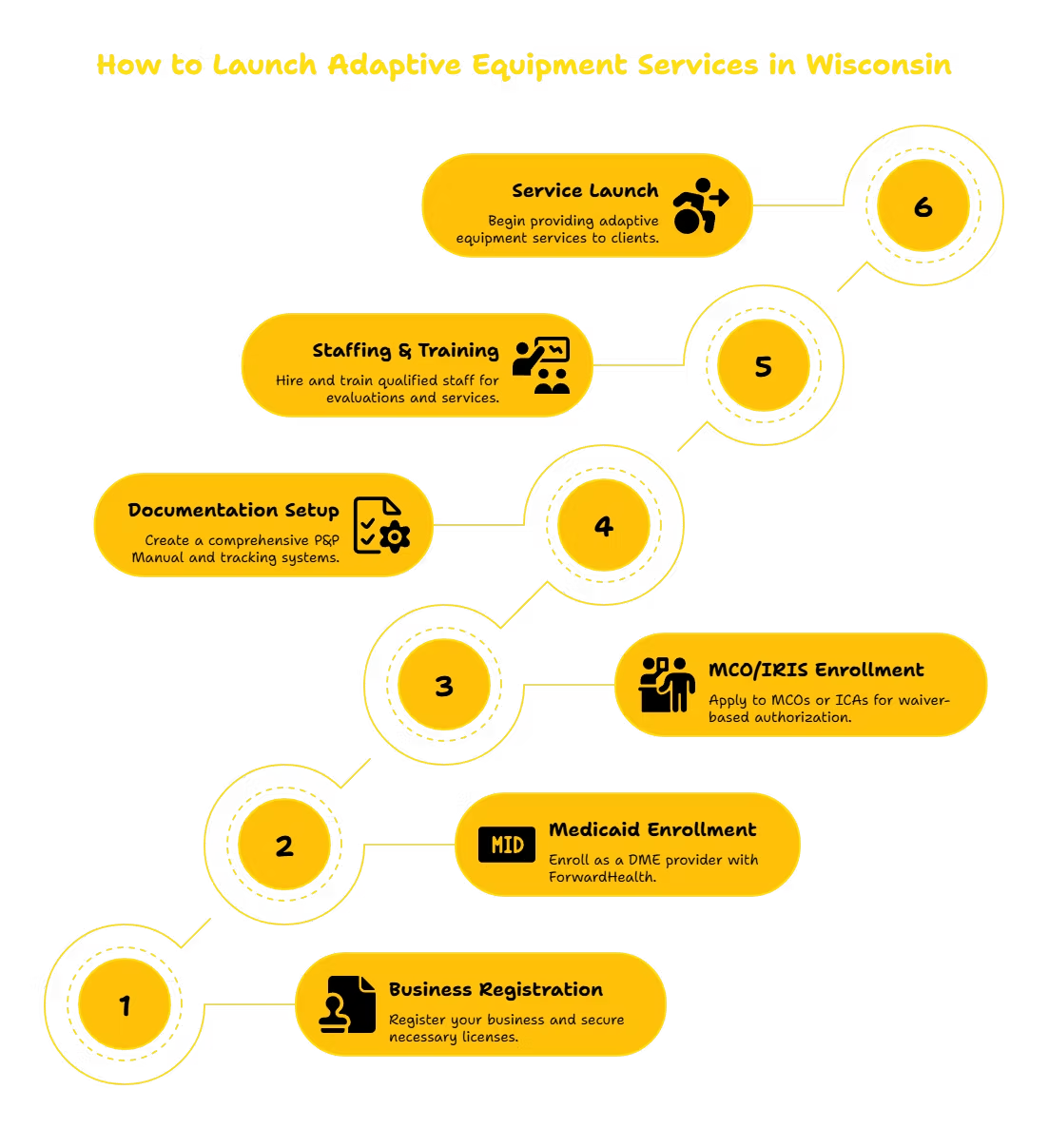
Key Takeaway: Successfully launching an adaptive equipment agency in Wisconsin requires a disciplined integration of business registration, state-mandated provider enrollment, and a robust, clinically-informed P&P manual. By aligning operations with the specific requirements of ForwardHealth, MCOs, and IRIS agencies, providers can build a sustainable and compliant service that significantly impacts the lives of individuals with disabilities.
Last verified: October 2023. This content is for informational purposes only and does not constitute legal or professional advice. Requirements for Medicaid and waiver programs are subject to change; always consult the official Wisconsin Department of Health Services (DHS) and ForwardHealth websites for the most current policies and provider guidelines.