ADAPTIVE EQUIPMENT SERVICES PROVIDER IN WASHINGTON
By Fatumata Kaba · 2026-04-06 · 5 min read
Becoming an adaptive equipment services provider in Washington is a critical step for businesses aiming to support the independence and safety of individuals enrolled in Home and Community-Based Services (HCBS) waivers. By supplying specialized medical devices and assistive technology, your organization helps participants navigate daily living challenges, ensuring they remain integrated within their homes and communities while meeting the strict regulatory standards set by the Developmental Disabilities Administration (DDA) and the Health Care Authority (HCA).
This guide serves as a foundational roadmap for prospective providers. Navigating the intersection of Medicaid requirements, clinical justification, and state-specific procurement protocols requires a structured approach to ensure your business remains compliant, efficient, and capable of serving the vulnerable populations supported by Washington’s Medicaid programs.
What Are the Governing Bodies and Their Roles?
To operate successfully as an adaptive equipment provider, you must align your business operations with the mandates of three primary agencies. Understanding the division of labor between these organizations is essential for navigating the authorization, billing, and compliance lifecycle of every piece of equipment provided.
The Developmental Disabilities Administration (DDA) is the primary contact for participants with developmental disabilities. Their role involves assessing the specific needs of the participant, authorizing equipment through the Person-Centered Service Plan (PCSP), and monitoring the quality of service delivery. In contrast, the Health Care Authority (HCA) serves as the fiscal and regulatory anchor, overseeing Medicaid funding, claims reimbursement, and statewide compliance standards for all Apple Health programs.
Additionally, the Department of Social and Health Services (DSHS) coordinates with the DDA and the Aging and Long-Term Support Administration (ALTSA). While the DDA focuses on developmental needs, ALTSA supports aging populations and those with physical disabilities. As a provider, you will likely interact with these departments to verify client eligibility, submit documentation for prior authorization, and ensure that all equipment fits within the defined scope of the participant’s specific waiver program.
What Equipment Qualifies for Medicaid Reimbursement?
Adaptive equipment encompasses a broad range of tools designed to enhance functional autonomy. To be reimbursable through Medicaid, every item must be deemed medically necessary, functionally justified, and explicitly listed within the participant’s PCSP. Equipment that does not meet these criteria—or that replicates services already provided under another program—will be denied funding.
Covered items typically focus on improving personal safety, mobility, and the performance of activities of daily living (ADLs). This includes high-tech communication aids, such as augmentative and alternative communication (AAC) devices, as well as low-tech environmental modifications like grab bars, shower chairs, and transfer benches. Advanced smart-home technologies that allow individuals with severe mobility impairments to control lights, alarms, and doors are also increasingly common under these programs.
- Activities of daily living (ADL) support tools like adaptive utensils and reachers.
- Mobility and transfer aids including specialized lifts and transfer benches.
- Communication and sensory access devices for individuals with speech or visual impairments.
- Personal safety and environmental control units, such as voice-activated smart home systems.
- Pressure relief items like specialized bedding and custom-fit cushions.
How Do You Enroll as a Washington Medicaid Provider?
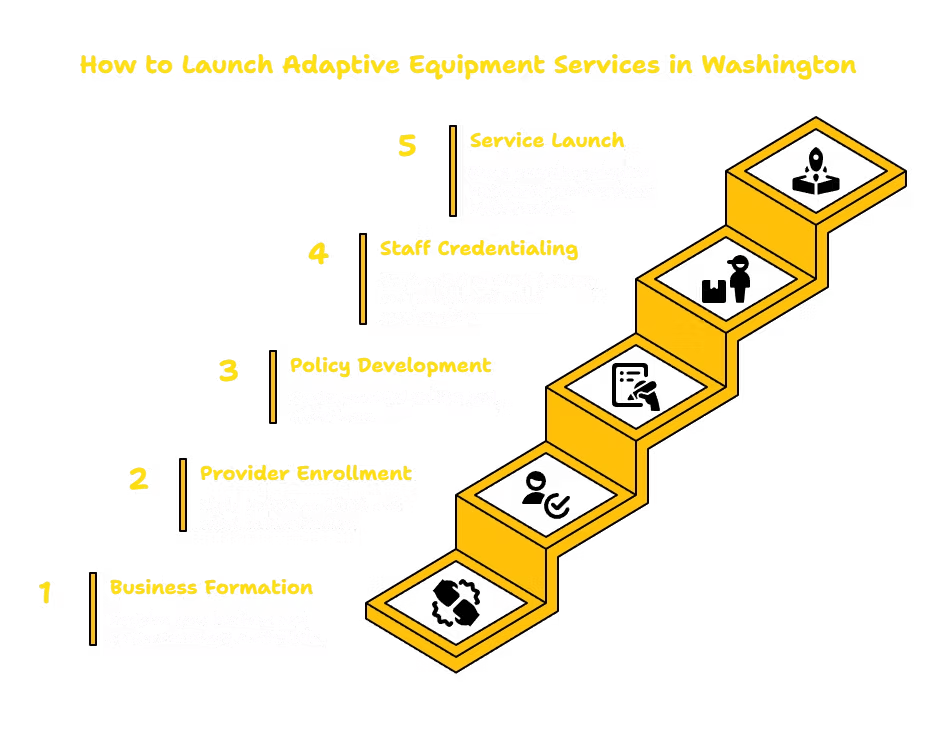
The enrollment process is a multi-step sequence that requires careful attention to detail. You must begin by establishing your business legal entity with the Washington Secretary of State, obtaining a Federal Employer Identification Number (EIN), and securing a Type 2 National Provider Identifier (NPI). These are the prerequisites for any entity entering the Medicaid billing landscape.
Once your business structure is established, you must enroll in the ProviderOne portal, which serves as the central hub for all Medicaid billing and provider credentialing in Washington. Simultaneously, you must seek a contract with the DDA or ALTSA specifically for adaptive equipment. This dual-track process ensures that you are both recognized as a legitimate business entity by the state and authorized as a specialized vendor to provide services to waiver-enrolled individuals.
- Register your business and obtain your EIN and NPI.
- Apply to the DDA or ALTSA for qualification as an authorized equipment vendor.
- Enroll in the ProviderOne portal using the appropriate taxonomies for DME or rehab equipment.
- Develop a comprehensive Policy & Procedure Manual specific to your service offerings.
- Finalize background checks and secure mandatory liability insurance coverage.
What Are the Essential Documentation and Staffing Requirements?
Success in this field relies heavily on your ability to maintain precise records. A robust Policy & Procedure Manual is required to demonstrate to the state that you have established protocols for client assessment, device selection, and coordination with prescribing therapists. This manual must also cover sensitive areas such as HIPAA compliance, grievance procedures, and the specific maintenance protocols required for the equipment you supply.
Staffing must be equally rigorous. Your team should include equipment specialists or technicians who have direct experience in fitting, installing, and repairing medical devices. For complex equipment, many providers integrate or consult with licensed physical or occupational therapists to provide the necessary clinical justification for purchases. Regardless of their role, every staff member must undergo comprehensive background checks and receive documented training on abuse prevention, emergency response, and patient confidentiality.
Frequently Asked Questions
Does Medicaid cover equipment for every waiver participant?
No, coverage depends on the specific waiver (such as Basic Plus, Core, or IFS) and the participant’s individual service plan. Each item must be pre-authorized and demonstrated as medically necessary for the specific individual.
Can we bill for equipment training?
Yes, training is often a component of service delivery. Providers are expected to educate the participant and their caregivers on the safe and effective usage of the device, which should be outlined in your service delivery procedures.
What if the equipment we provide is covered by another funding source?
Medicaid is the payer of last resort. You must ensure that the equipment requested has not already been funded by another source, such as private insurance or other state programs, to avoid billing fraud or duplication of services.
Timeline for Program Implementation
Launching a new adaptive equipment agency typically takes three to six months, depending on the speed of regulatory approval. The initial 2–4 weeks are spent on legal business formation and NPI acquisition. The most intensive phase involves contracting with DDA/ALTSA and ProviderOne enrollment, which usually spans 1–2 months. During this period, you should finalize your operational manuals and begin staff credentialing to ensure a seamless launch once referrals start arriving from case managers.
Waiver Consulting Group provides targeted assistance to equipment vendors and clinical teams to streamline this process. We help agencies develop the necessary documentation, including policy manuals, delivery checklists, and inventory tracking systems, to ensure full compliance with Washington Medicaid standards from day one.
Key takeaway: Providers must focus on the integration of clinical necessity and rigorous administrative documentation; success in the Washington HCBS landscape is defined by your ability to bridge the gap between technical equipment expertise and Medicaid billing compliance.
Last verified: October 2023. Disclaimer: This information is for educational purposes and does not constitute legal or professional medical advice. Always refer to the most recent DSHS, DDA, and HCA policy manuals for current regulatory updates.