ADAPTIVE EQUIPMENT SERVICES PROVIDER IN VIRGINIA
By Fatumata Kaba · 2026-04-08 · 5 min read
ENABLING INDEPENDENCE, SAFETY, AND MOBILITY THROUGH SPECIALIZED EQUIPMENT THAT SUPPORTS INDIVIDUAL NEEDS IN HOME AND COMMUNITY SETTINGS
Adaptive Equipment Services in Virginia provide individuals with disabilities or chronic conditions access to medically necessary tools and technologies that promote independence, communication, mobility, and daily functioning. These services ensure that participants in Medicaid waiver programs have the equipment needed to live safely and successfully outside of institutional settings, with coverage provided under Virginia’s Community Living (CL), Family and Individual Supports (FIS), and Commonwealth Coordinated Care Plus (CCC Plus) Waivers.
Oversight for these critical services is provided by the Department of Medical Assistance Services (DMAS), while service coordination and authorization are managed by Community Services Boards (CSBs) or Managed Care Organizations (MCOs). Providers in this sector play a vital role in the healthcare continuum, facilitating the acquisition, customization, and training of devices that significantly improve the quality of life for waiver participants.
How Do Governing Agencies Regulate Adaptive Equipment Services?
The regulatory framework for Adaptive Equipment Services is designed to ensure participant safety and fiscal accountability. The Virginia Department of Medical Assistance Services (DMAS) serves as the primary governing agency, responsible for administering Medicaid waiver services and establishing the reimbursement policies that define provider participation. By setting these standards, DMAS ensures that all equipment provided under the waiver is both medically necessary and cost-effective.
Operational oversight is delegated to Community Services Boards (CSBs) and Managed Care Organizations (MCOs) depending on the participant's specific waiver program. For individuals enrolled in the Community Living (CL) or Family and Individual Supports (FIS) Waivers, CSBs authorize equipment requests and ensure they align with the participant's Individual Support Plan (ISP). For those under the CCC Plus Waiver, MCOs are responsible for managing service authorizations and processing reimbursement claims, making it essential for providers to maintain strong communication with these entities.
What Items Qualify as Adaptive Equipment Services?
Adaptive Equipment Services encompass the assessment, procurement, delivery, customization, and user training of durable and adaptive items that increase a participant's ability to perform Activities of Daily Living (ADLs) and Instrumental Activities of Daily Living (IADLs). To qualify for coverage, each item must be identified within the participant's ISP or Plan of Care (POC), deemed medically necessary by a qualified professional, and unavailable through other insurance coverage.
Commonly covered items include the following:
- Mobility devices, including manual or power wheelchairs and walkers
- Adaptive utensils, reachers, and specialized transfer aids
- Bathing and toileting safety equipment for home modifications
- Communication devices, such as speech-generating technologies
- Durable medical equipment including hospital beds, hoyer lifts, and gait trainers
- Modified computer setups or remote access environmental control devices
What Are the Licensing and Provider Approval Requirements?
Establishing an agency to provide Adaptive Equipment Services requires strict adherence to state and federal mandates. Before delivering any goods, an entity must register with the Virginia State Corporation Commission (SCC) and obtain an Employer Identification Number (EIN) along with a Type 2 National Provider Identifier (NPI). Depending on the specific equipment provided, businesses may also need to register with the FDA as a medical device distributor and secure appropriate retail or DME supplier credentials.
Provider approval hinges on the development of a comprehensive Adaptive Equipment Services Policy & Procedure Manual. This document serves as the foundation for clinical and operational compliance. Once documentation is finalized, providers must enroll through the DMAS Medicaid Enterprise System (MES) portal. Following enrollment, providers must establish contracts with the relevant CSBs or MCOs to begin receiving referrals and authorizations for their services.
What Is the Required Documentation for Service Delivery?
Maintaining meticulous documentation is a regulatory necessity for Medicaid providers. At a minimum, every provider must retain proof of corporate registration, NPI/EIN records, and a signed Medicaid provider agreement. Every equipment request must be backed by an authorization form issued by the MCO or CSB. These records are subject to audit and must demonstrate the medical necessity of the equipment provided.
Beyond basic business documents, the provider’s internal manual must detail specific protocols for safe service delivery. Required documentation categories include:
- Equipment procurement, customization, and safety testing logs
- Standardized delivery and setup confirmation protocols
- Comprehensive user training and caregiver education records
- Manufacturer warranty information and established repair service policies
- Risk assessment documents and post-delivery functionality evaluations
- HIPAA-compliant client confidentiality and data protection forms
What Are the Staffing and Training Expectations?
Staffing requirements center on safety, technical competency, and the ability to educate caregivers. Every Equipment Technician or Delivery Specialist must undergo rigorous background checks and receive documented safety training. These individuals are responsible for the physical installation of devices and must possess the professional skill to demonstrate proper usage to the participant and their primary caregivers.
While not universally mandatory for all roles, employing or contracting an Assistive Technology Professional (ATP) or a certified Rehab Specialist is highly recommended. These professionals provide the technical oversight necessary for complex assessments and equipment selection. All staff must complete ongoing training in HIPAA confidentiality, incident reporting, and alignment with ISP requirements to ensure that the equipment provided effectively meets the individual’s long-term care goals.
Frequently Asked Questions
What is the timeline to launch an Adaptive Equipment business?
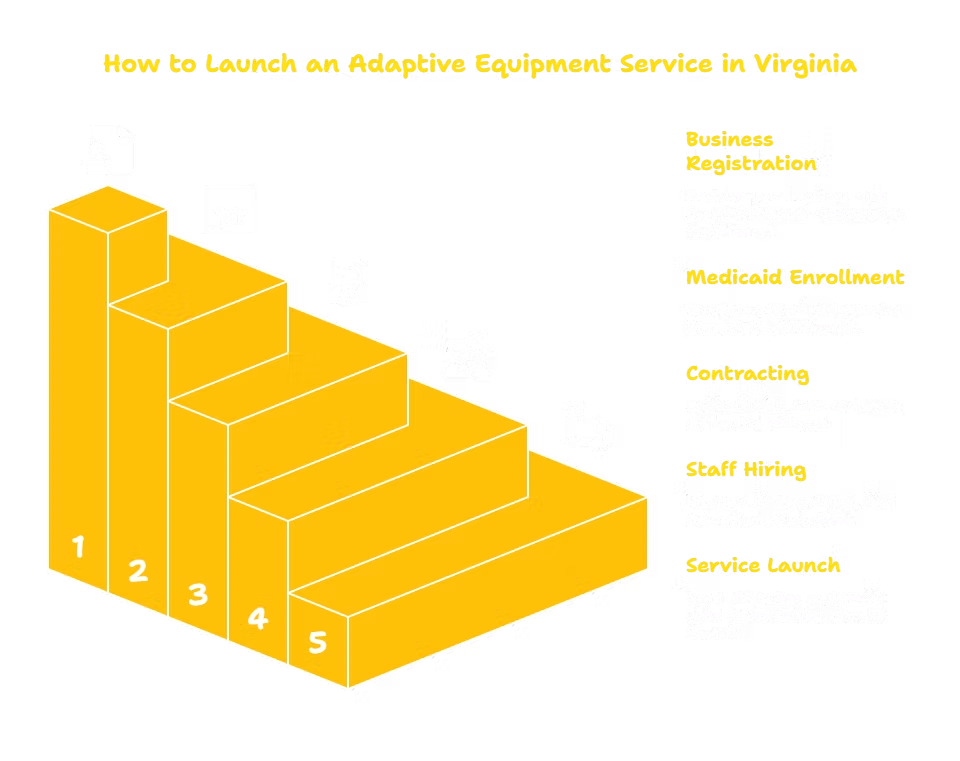
The launch process generally takes 8–15 weeks. Business registration and policy manual development typically require 2–3 weeks, followed by 4–6 weeks for Medicaid enrollment and contracting. Final preparations, including staff hiring and internal readiness reviews, usually span another 2–4 weeks.
Do I need to be a licensed DME provider to participate?
Depending on the specific scope of equipment provided, you may need specific DME supplier credentialing or a retail sales license. Always confirm the specific regulatory requirements for the types of devices your agency plans to supply through the Virginia DMAS provider portal.
How are equipment requests authorized?
Requests must originate from the participant’s Individual Support Plan (ISP) or Plan of Care (POC). Once the need is identified, the request is submitted to the assigned CSB or MCO for review and final authorization before the equipment can be procured or delivered.
Key Takeaway: Success as an Adaptive Equipment provider in Virginia requires a dual focus on rigorous Medicaid compliance and high-quality technical service. By maintaining robust documentation, adhering to DMAS enrollment standards, and ensuring staff are properly trained in equipment safety and user instruction, providers can effectively support the independence of waiver participants while maintaining a sustainable and compliant business model.
Waiver Consulting Group (WCG) supports providers offering assistive and adaptive technologies with full setup services, compliance documentation, and Medicaid readiness. Our services include Medicaid provider enrollment support, the creation of tailored Policy & Procedure Manuals, and the development of standardized equipment delivery logs and staff training templates.
Last verified: 2024. The information provided is for general educational purposes and does not constitute legal or professional advice. Always verify current requirements via the official Virginia Department of Medical Assistance Services (DMAS) website and relevant state statutes.