ADAPTIVE EQUIPMENT SERVICES PROVIDER IN VERMONT
By Fatumata Kaba · 2026-04-09 · 5 min read
SUPPORTING INDEPENDENT LIVING THROUGH CUSTOMIZED DEVICES THAT ENHANCE MOBILITY, COMMUNICATION, AND DAILY FUNCTIONING
Adaptive Equipment Services in Vermont are critical supports that provide individuals with disabilities access to essential devices, ensuring safety, independence, and improved participation in community life. These services encompass the professional evaluation, acquisition, customization, and ongoing maintenance of mobility aids, communication systems, and functional tools specifically designed to meet an individual's disability-related needs.
How Do Adaptive Equipment Services Function Within Vermont’s HCBS Framework?
Adaptive Equipment services operate under the umbrella of Vermont’s Medicaid Home and Community-Based Services (HCBS) waivers. For a service to be reimbursable, the equipment must be directly linked to a participant's functional needs as outlined in their Individual Support Plan (ISP). This ensures that every device provided is medically necessary and tailored to the unique circumstances of the individual, rather than serving a purely recreational purpose.
The system relies on a collaborative oversight structure. The Department of Disabilities, Aging and Independent Living (DAIL) is responsible for authorizing services and ensuring alignment with the ISP. Meanwhile, Designated Agencies (DAs) and Specialized Services Agencies (SSAs) act as the primary coordinators, managing the development of the ISP and validating the functional assessments that justify the acquisition of specific equipment.
What Are the Primary Governing Agencies and Their Responsibilities?
Navigating the Vermont Medicaid landscape requires an understanding of the distinct roles played by state entities. The Department of Disabilities, Aging and Independent Living (DAIL) serves as the primary authority for service authorization, verifying that all adaptive equipment requests meet strict criteria for medical necessity and ISP integration. Without DAIL’s oversight, equipment procurement cannot proceed through the waiver programs.
Complementing this, the Department of Vermont Health Access (DVHA) handles the financial and administrative aspects of the program. They are responsible for the enrollment of providers and the subsequent processing of claims for reimbursement. Providers must maintain a professional relationship with these agencies, ensuring that all documentation—from clinical justification to procurement receipts—is accurate and readily available for audits.
- Department of Disabilities, Aging and Independent Living (DAIL): Authorizes services and ensures clinical alignment.
- Department of Vermont Health Access (DVHA): Processes Medicaid enrollment and handles billing/reimbursement.
- Designated Agencies (DAs) / Specialized Services Agencies (SSAs): Coordinate ISP development and authorize local equipment needs.
What Are the Requirements for Provider Licensing and Approval?
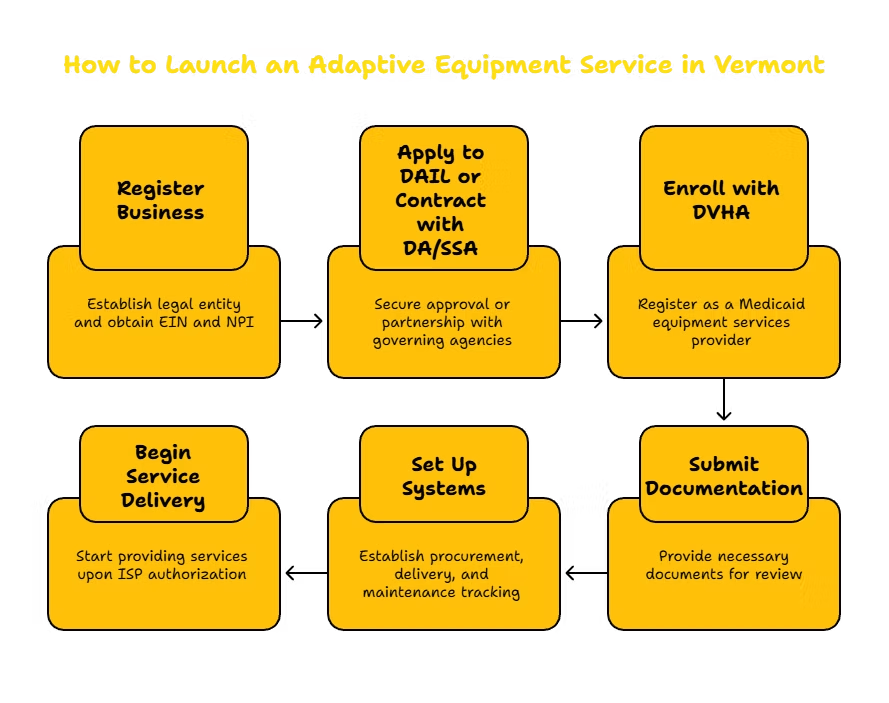
Becoming an approved provider of Adaptive Equipment in Vermont is a multi-step regulatory process. Prospective businesses must first establish a legal foundation by registering with the Vermont Secretary of State, followed by obtaining a federal Employer Identification Number (EIN) and a Type 2 National Provider Identifier (NPI). These are standard prerequisites for any entity looking to interact with the state's Medicaid reimbursement systems.
Beyond basic business registration, agencies must formalize their operational capacity. This includes contracting directly with a Designated Agency or pursuing provider status through DAIL. Providers must demonstrate that they can maintain general liability insurance, provide comprehensive device warranties, and uphold strict documentation standards. For providers offering evaluative services, it is mandatory to collaborate with licensed clinicians such as Occupational Therapists (OT), Physical Therapists (PT), or Speech-Language Pathologists (SLP) to ensure the clinical integrity of the prescribed equipment.
How Is the Provider Enrollment Process Structured?
The enrollment path is designed to ensure that only qualified vendors supply sensitive medical and functional equipment. The process begins with basic business documentation and progresses to specialized Medicaid enrollment. Once an agency has obtained its EIN and NPI, it must submit its credentials, including staff qualifications and vendor partnerships, to the appropriate state or agency oversight body. Following the successful review of a comprehensive Policy & Procedure Manual, the provider must establish robust procurement and maintenance systems.
Service delivery can only commence once the provider is fully enrolled and a specific participant’s ISP has been approved. The workflow for procurement, delivery, and ongoing maintenance must be tracked meticulously. Providers must also maintain proof of clinical justification, as this documentation is the cornerstone of any Medicaid audit. Throughout this process, constant communication with case managers at DAs and SSAs is essential to keep service authorizations current.
What Documentation Is Required for Compliance and Audit Readiness?
Maintaining a high standard of documentation is the most effective way to ensure long-term sustainability as a Medicaid provider. Every provider should maintain a detailed Policy & Procedure Manual that serves as the organization's operational roadmap. This manual must explicitly cover workflows for equipment procurement, installation, and, crucially, the repair and maintenance schedules that keep equipment safe for participant use.
Internal controls must also be in place to manage data security. Given the nature of the work, HIPAA compliance is non-negotiable. Providers are expected to maintain comprehensive records, including:
- Detailed equipment procurement, delivery, and installation logs.
- Safety, troubleshooting, and maintenance documentation for all hardware.
- Client rights, informed consent, and HIPAA-compliant data security protocols.
- Evidence of coordination with external therapists and support coordinators.
- Tracking forms that confirm equipment receipt and assess participant satisfaction.
Frequently Asked Questions
What criteria make equipment eligible for Medicaid reimbursement in Vermont?
Equipment must be medically necessary, directly linked to a disability-related need, and specifically authorized in the participant's Individual Support Plan (ISP). Items deemed purely recreational or duplicative of other covered benefits are not eligible for reimbursement.
Which waiver programs cover Adaptive Equipment services?
Coverage is generally available through the Developmental Disabilities Services Waiver (DDSW), Choices for Care (CFC) Waiver, the Brain Injury Program, and the Children’s Personal Care and High-Tech Waivers. Limited coverage may be available under the Attendant Services Program (ASP) based on demonstrated functional need.
What are the primary staffing requirements for an equipment provider?
Staff should have verified experience with assistive technology or rehabilitation equipment. Depending on the equipment, manufacturer certifications for installation may be required. All staff must undergo background checks, HIPAA training, and device safety instruction to ensure participant well-being.
Key Takeaway for New Providers
Establishing an Adaptive Equipment service in Vermont requires a rigorous commitment to the regulatory standards set by DAIL and DVHA. By focusing on the development of a strong operational manual, ensuring seamless coordination with Designated Agencies, and maintaining strict adherence to clinical justification and documentation requirements, providers can successfully support the independence and functional goals of their participants while remaining compliant with Medicaid policies.
Last verified June 2024. This content is for informational purposes only and does not constitute legal or professional medical advice. Always consult with the Vermont Department of Disabilities, Aging and Independent Living (DAIL) or official state documentation for the most current regulatory requirements.