ADAPTIVE EQUIPMENT SERVICES PROVIDER IN TEXAS
By Fatumata Kaba · 2026-03-30 · 5 min read
ENABLING INDEPENDENCE AND FUNCTIONAL LIVING THROUGH CUSTOMIZED MEDICAL AND NON-MEDICAL EQUIPMENT FOR TEXANS WITH DISABILITIES
Adaptive Equipment Services in Texas provides essential Medicaid-funded devices and specialized technology designed to assist individuals with disabilities in performing daily activities and achieving greater independence within their homes and communities. These critical services are delivered through Texas Health and Human Services Commission (HHSC) programs, primarily authorized under 1915(c) Home and Community-Based Services (HCBS) Waivers, including the Community Living Assistance and Support Services (CLASS), Deaf Blind with Multiple Disabilities (DBMD), Home and Community-based Services (HCS), and Texas Home Living (TxHmL) programs.
What Are the Governing Agencies and Regulatory Frameworks for Adaptive Equipment?
The delivery of adaptive equipment is strictly regulated to ensure that participants receive high-quality, safe, and effective tools that meet their specific functional needs. The primary state authority is the Texas Health and Human Services Commission (HHSC), which administers the state’s Medicaid waiver programs, establishes specific adaptive equipment service standards, approves prospective providers, and oversees the complex reimbursement processes required for these services.
At the federal level, the Centers for Medicare & Medicaid Services (CMS) provides the overarching regulatory framework. CMS ensures that Texas Medicaid waiver programs, including the specific provisions for equipment coverage, remain compliant with federal HCBS requirements. This federal-state partnership guarantees that equipment provided is not only medically necessary but also promotes community integration and adheres to standardized safety protocols.
What Does the Scope of Adaptive Equipment Services Include?
Adaptive Equipment Services encompasses a broad range of customized or specialized devices used to increase, maintain, or improve an individual’s functional capabilities and safety. Because these items are funded through specific Medicaid waivers, they must be documented as medically necessary and explicitly approved within the participant’s Individual Plan of Care (IPC) or Person-Directed Plan (PDP).
Covered items generally include, but are not limited to, the following categories:
- Wheelchairs (manual, power) and specialized seating systems
- Communication devices, such as speech-generating devices and augmentative tools
- Transfer devices, including slings, lifts, and gait belts
- Positioning supports like standers, wedges, and special mattresses
- Adaptive daily living aids, including specialized utensils and bathing equipment
- Environmental control units, such as switches, remote controls, and voice-activated technology
- Specialized computer hardware and software designed for education, employment, or communication needs
How Do Providers Navigate the Enrollment and Licensing Process?
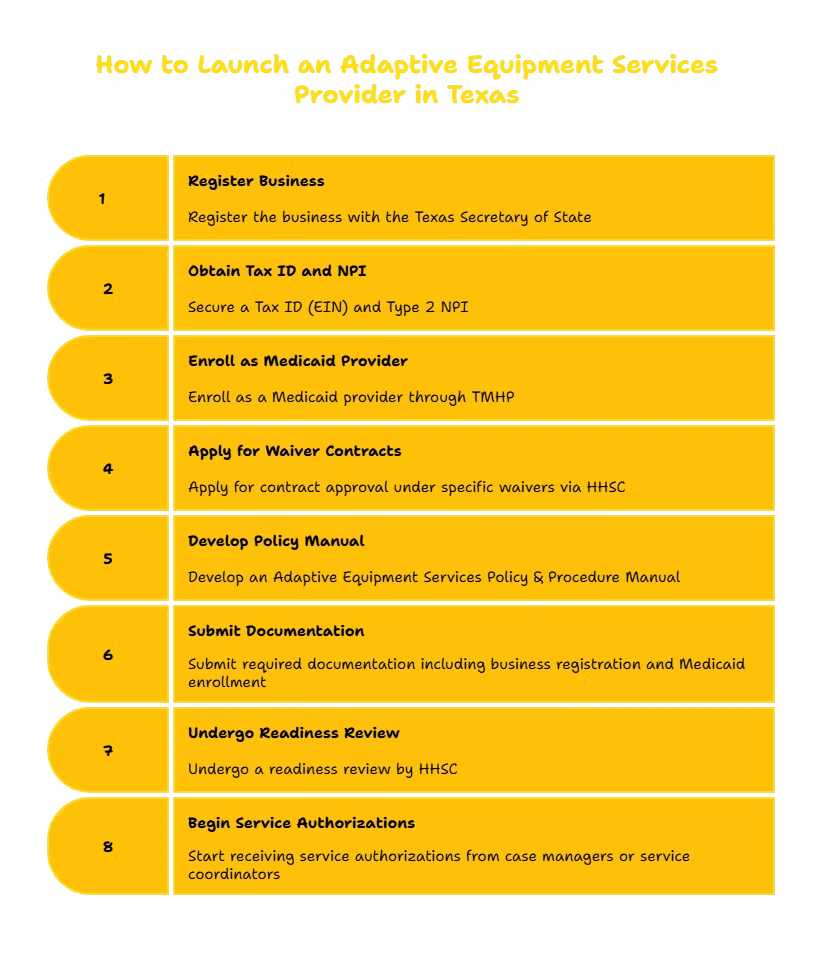
Becoming an approved Medicaid provider for adaptive equipment is a multi-phased process that requires strict attention to administrative detail. Prospective agencies must first establish their business legal structure with the Texas Secretary of State and secure a federal Employer Identification Number (EIN) and a Type 2 National Provider Identifier (NPI). These foundational credentials are mandatory for all subsequent government applications.
Once the entity is registered, the provider must enroll in the Texas Medicaid program through the Texas Medicaid & Healthcare Partnership (TMHP). This involves utilizing the Provider Enrollment on the Portal (PEP) system. Following successful Medicaid enrollment, the provider must apply for specific contract approvals with the HHSC for the waiver programs they intend to serve, such as HCS, CLASS, or DBMD. Readiness reviews by the state are common, ensuring that the agency has the documented capacity to assess, procure, and deliver equipment according to state standards.
What Documentation Is Required for Regulatory Compliance?
Maintaining a high level of documentation is the cornerstone of a successful Adaptive Equipment Services operation. Providers are expected to maintain an Adaptive Equipment Services Policy & Procedure Manual that outlines every phase of the service cycle. This manual should serve as the agency’s internal roadmap for compliance and quality assurance, covering everything from the initial referral to final equipment installation.
The following documentation areas must be robustly addressed within the agency’s administrative files:
- Referral, evaluation, and recommendation procedures, including clinical oversight records
- Evidence of equipment procurement, installation, and user-training logs
- Documentation confirming client instruction, usage verification, and overall satisfaction
- Detailed maintenance, repair, and replacement policies for all distributed devices
- HIPAA-compliant record-keeping and inventory control systems
- Billing logs and authorization tracking templates that align with TMHP requirements
What Are the Staffing and Training Mandates?
Success in this field relies on a workforce that understands both technical equipment requirements and the nuances of waiver compliance. The Adaptive Equipment Coordinator or Vendor Liaison serves as the primary point of contact for case managers and service coordinators. This role requires significant experience with Durable Medical Equipment (DME), assistive technology, or rehabilitation equipment.
Where clinical assessments are required to prove medical necessity, the provider must coordinate with a licensed Occupational or Physical Therapist. Furthermore, equipment technicians or installers must receive specific training regarding device setup, safety protocols, and user support. All staff must regularly participate in training modules covering HCBS waiver documentation practices, HIPAA regulations, abuse prevention, and established safety protocols to ensure the ongoing welfare of the individuals being served.
Frequently Asked Questions
What is the typical timeline to launch an Adaptive Equipment agency?
The launch timeline is generally divided into phases: 1–2 months for business formation and policy development, 2–4 months for TMHP and HHSC contract applications, and 30–60 days for staff onboarding and vendor agreements. Total time to operational status is dependent on the speed of government processing and the complexity of the initial readiness review.
Which Medicaid waivers cover these services?
Adaptive Equipment Services are covered under several key programs, including HCS (Home and Community-Based Services), TxHmL (Texas Home Living), CLASS (Community Living Assistance & Support Services), and DBMD (Deaf Blind with Multiple Disabilities). Limited equipment access may also be available under the YES Waiver for behavioral health needs and the Medically Dependent Children Program (MDCP) through therapist coordination.
What does WCG assist with for new providers?
Waiver Consulting Group (WCG) supports providers in navigating the TMHP and HHSC enrollment processes. This includes the development of Adaptive Equipment Services Policy Manuals, equipment procurement and delivery documentation templates, clinical assessment coordination tools, installation checklists, and authorization tracking systems necessary for successful audits.
Key Takeaway: Successful operation as an adaptive equipment provider in Texas requires a dual focus: technical proficiency in assistive technology and strict adherence to the administrative and compliance standards set forth by TMHP and HHSC. Agencies that prioritize thorough documentation, qualified staff, and streamlined referral tracking are best positioned to deliver consistent, life-changing support to Texans with disabilities.
Last verified: May 2024. This information is for educational purposes only and does not constitute legal or professional advice. Always refer to the most recent Texas Health and Human Services Commission (HHSC) and Texas Medicaid & Healthcare Partnership (TMHP) provider handbooks for official program requirements and updates.