ADAPTIVE EQUIPMENT SERVICES PROVIDER IN SOUTH DAKOTA
By Fatumata Kaba · 2025-10-15 · 5 min read
SUPPORTING SAFETY, INDEPENDENCE, AND DAILY FUNCTION THROUGH SPECIALIZED EQUIPMENT FOR INDIVIDUALS WITH DISABILITIES
Adaptive Equipment Services in South Dakota provide Medicaid-funded evaluation, acquisition, customization, and maintenance of assistive devices that enable individuals with disabilities to perform daily living tasks, improve mobility, or communicate more effectively. These services are essential components of Home and Community-Based Services (HCBS) waivers, including the CHOICES Waiver, Family Support 360 Waiver, and the Medically Fragile Waiver, and are formally authorized by the South Dakota Department of Human Services (DHS) and Department of Social Services (DSS).
Understanding the Governance of Adaptive Equipment in South Dakota
The provision of adaptive equipment operates under a collaborative oversight framework involving state and federal authorities. The South Dakota Department of Human Services (DHS) – Division of Developmental Disabilities (DDD) serves as the primary regulatory body for waiver programs. This division holds the responsibility of authorizing specific adaptive equipment requests within a participant’s service plan and ensuring that all enrolled providers remain in compliance with state standards for service delivery.
Complementing the role of the DHS, the South Dakota Department of Social Services (DSS) – Medical Services Division manages the fiscal aspects of the program. This includes oversight of Medicaid billing policies, claims processing, and the administration of durable medical equipment (DME) benefits. At the federal level, the Centers for Medicare & Medicaid Services (CMS) dictates the baseline requirements for HCBS waivers and State Plan benefits, ensuring that South Dakota’s programs align with national standards for accessibility, quality, and participant safety.
Navigating these regulatory layers requires a clear understanding of the hierarchy of oversight. Providers must ensure that their operational workflows satisfy both the clinical authorization requirements set by the DDD and the financial documentation requirements mandated by the DSS.
Scope and Delivery of Adaptive Equipment Services
Adaptive equipment is broadly defined as any item, device, or product system used to increase, maintain, or improve the functional capabilities of individuals with disabilities. For an agency to operate effectively in this space, it must support the entire lifecycle of a device, from the initial clinical identification of need through the long-term maintenance of the equipment. This ensures that the participant receives a device that is not only medically necessary but also correctly fitted and functional for their specific environment.
The scope of professional services provided by an adaptive equipment agency typically includes the following core operational tasks:
- Conducting functional assessments to identify specific equipment needs in coordination with prescribing therapists.
- Procurement, delivery, and professional installation of approved devices.
- Customization and fitting of equipment to ensure ergonomic safety and efficacy.
- Instruction and training for the participant and their caregivers on safe device operation.
- Ongoing maintenance, urgent repairs, and periodic adjustments.
- Managing complex billing documentation, including medical necessity forms and prior authorization requests.
Requirements for Provider Enrollment and Compliance
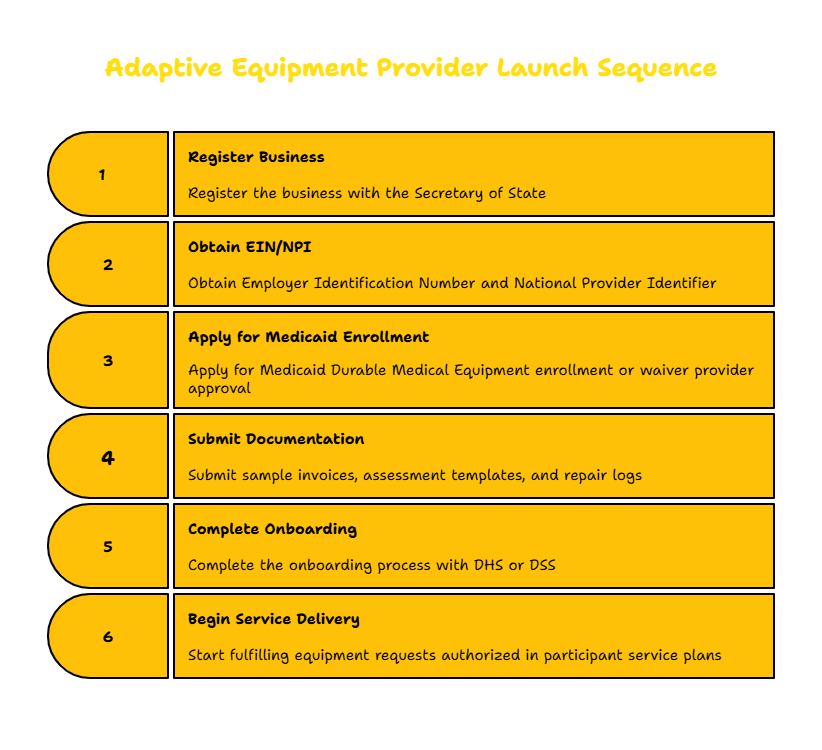
Becoming an approved Medicaid provider in South Dakota requires a structured approach to institutional readiness. Before a provider can bill for services, they must establish a formal business entity registered with the South Dakota Secretary of State and secure a federal Employer Identification Number (EIN) and a Type 2 National Provider Identifier (NPI). This foundational step is necessary to interface with Medicaid claims systems.
Once registered, providers must navigate the specific enrollment pathways offered by the DHS-DDD or the DSS. This process serves as a vetting mechanism to ensure that the entity possesses the infrastructure to deliver specialized equipment. Key requirements for maintaining active provider status include:
- Maintaining active liability insurance coverage.
- Developing and documenting comprehensive internal Adaptive Equipment Services Policies and Procedures.
- Establishing formal partnerships with licensed therapists, such as Occupational Therapists (OT), Physical Therapists (PT), or Speech-Language Pathologists (SLP), for clinical assessments.
- Retaining detailed records of warranties, equipment repair logs, and service delivery verification.
Staffing Standards and Operational Documentation
A successful adaptive equipment program relies on personnel who are proficient in both the technical aspects of the devices and the administrative rigor of Medicaid compliance. The primary role within the organization is the Equipment Specialist or Provider Technician. These individuals must possess deep knowledge of durable medical equipment and maintain current documentation for all background checks and training certifications.
The organization must also maintain a robust internal manual that governs its daily operations. This documentation serves as the blueprint for organizational compliance and must be available for review by state auditors. Essential documentation areas that must be addressed include:
- Workflow protocols for managing equipment requests from initial referral to final delivery.
- Standardized templates for justifying medical necessity to meet Medicaid requirements.
- Protocols for HIPAA compliance, ensuring that all participant data is protected during the collection, billing, and storage processes.
- Standardized delivery logs and training sign-off sheets that verify the participant received adequate education on the use of their new device.
Frequently Asked Questions
What types of adaptive equipment are typically covered?
Coverage generally includes items that promote functional independence, such as adaptive utensils, bath and shower chairs, patient lifts, speech-generating communication devices, adaptive computer access systems, and specialized wheelchair modifications or environmental control units.
How does a provider ensure that an item meets the definition of medical necessity?
Medical necessity is established through a clinical assessment performed by a licensed therapist (OT, PT, or SLP) or an authorized prescriber. The provider is responsible for compiling this clinical justification alongside the equipment request to meet the evidentiary standards required by the Department of Social Services.
What is the typical timeline to launch an adaptive equipment provider agency?
The launch process generally spans several months. Business registration and the creation of the required Policy & Procedure Manual typically take 1–2 months, while Medicaid enrollment and DME licensing can take an additional 2–3 months. Sourcing and documentation preparation often run concurrently, totaling a 4–6 month preparation phase before full service delivery begins.
Key Takeaways for Prospective Providers
Launching an adaptive equipment service in South Dakota requires a disciplined adherence to both clinical and administrative standards. By aligning organizational workflows with the requirements of the DHS-DDD and the DSS, providers can ensure they are well-positioned to serve participants under the CHOICES, Family Support 360, and Medically Fragile waivers. Success in this field is predicated on the dual commitment to high-quality equipment fitting and meticulous documentation practices, ensuring that Medicaid resources are utilized effectively to foster participant independence.
Last verified: September 2023. This content is provided for informational purposes only and does not constitute legal or professional advice. Always consult the official South Dakota Department of Human Services (DHS) and Department of Social Services (DSS) websites for the most current policies, provider manuals, and regulatory requirements.