ADAPTIVE EQUIPMENT SERVICES PROVIDER IN RHODE ISLAND
By Fatumata Kaba · 2025-10-09 · 5 min read
ENHANCING INDEPENDENCE AND SAFETY THROUGH CUSTOMIZED EQUIPMENT SOLUTIONS FOR INDIVIDUALS WITH DISABILITIES AND FUNCTIONAL LIMITATIONS
Adaptive Equipment Services in Rhode Island are essential Medicaid-funded supports designed to help individuals obtain, maintain, and utilize devices that promote greater independence within their homes and communities. These services are primarily funded through the state’s Medicaid 1115 Global Waiver and Developmental Disabilities (DD) Waivers, providing critical access to mobility aids, communication devices, self-care tools, and home accessibility supports that empower participants to lead self-directed lives.
Understanding the Governing Agency Landscape in Rhode Island
Operating as an adaptive equipment provider requires a comprehensive understanding of the multi-layered regulatory environment in Rhode Island. The Rhode Island Executive Office of Health and Human Services (EOHHS) serves as the primary authority, overseeing Medicaid authorization and reimbursement protocols for adaptive equipment and assistive technology. Establishing a firm grasp of these reporting lines is the first step toward successful service delivery.
Beyond EOHHS, the Department of Behavioral Healthcare, Developmental Disabilities & Hospitals (BHDDH) is responsible for authorizing and monitoring equipment services specifically under the DD Waivers for individuals with developmental disabilities. Providers must also remain compliant with federal guidelines established by the Centers for Medicare & Medicaid Services (CMS) regarding durable medical equipment and Home and Community-Based Services (HCBS) settings. Additionally, the Rhode Island Department of Health (RIDOH) maintains regulatory oversight of facilities or personnel involved in clinical assessments or medical-grade equipment customization.
- EOHHS: Manages overall Medicaid authorization and billing frameworks.
- BHDDH: Oversees specific DD Waiver programs and service monitoring.
- CMS: Sets the federal standard for HCBS compliance and funding.
- RIDOH: Regulates clinical environments and personnel licensure requirements.
Defining the Scope of Adaptive Equipment Services
Adaptive equipment providers play a multifaceted role in the lives of Medicaid participants. The scope of service extends well beyond the physical procurement of devices; it encompasses a holistic approach to functional improvement. This includes clinical assessment, customization to the participant’s specific environment, and rigorous training to ensure the equipment is used effectively and safely.
Approved providers are tasked with managing the entire lifecycle of an assistive device. This begins with the evaluation of functional needs by qualified therapists and moves through the procurement and fitting process. Ongoing support is equally critical, as providers are responsible for maintenance and repairs, ensuring that equipment remains functional over time. Precise documentation of these service milestones is mandatory to ensure ongoing compliance with Medicaid billing and clinical standards.
Navigating Licensing and Provider Enrollment Prerequisites
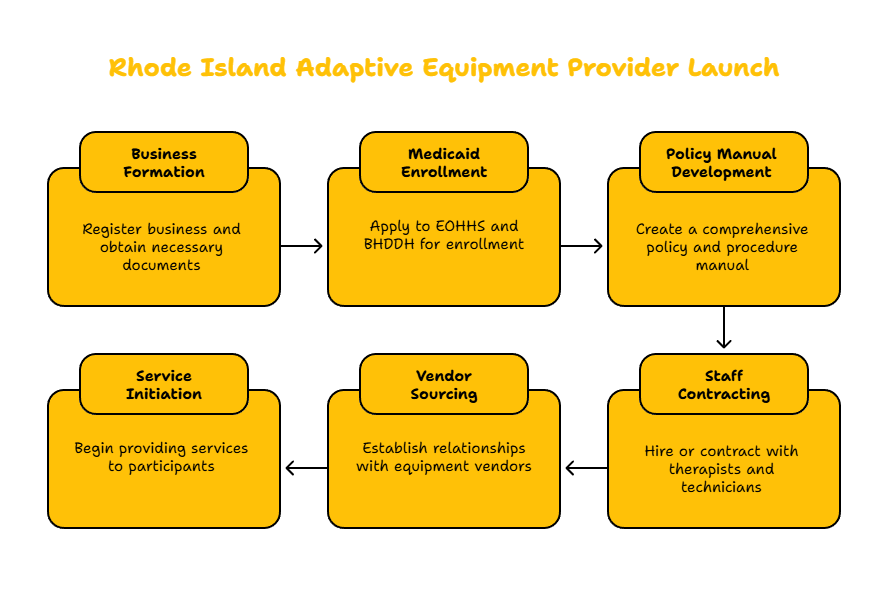
To enter the Rhode Island Medicaid provider network, organizations must adhere to a strict sequence of administrative prerequisites. Before seeking enrollment, businesses must be fully registered with the Rhode Island Secretary of State and possess a valid EIN and Type 2 NPI. These foundational steps ensure the business is recognized as a legal entity capable of entering into professional service agreements.
Providers must maintain comprehensive insurance policies, including product liability and general business coverage, to mitigate risks associated with equipment installation and use. Furthermore, organizations must develop a robust Adaptive Equipment Services Policy & Procedure Manual. This document acts as the internal blueprint for operations, detailing how the agency handles safety, training, and documentation to meet state expectations. Contracting with licensed occupational or physical therapists is often required to validate the clinical appropriateness of the equipment being supplied.
- Register business entity with the Rhode Island Secretary of State.
- Secure a federal EIN and a Type 2 NPI.
- Obtain necessary product liability and general business insurance.
- Develop an internal Policy & Procedure Manual for service delivery.
- Enroll as a Medicaid provider via the appropriate HCBS and DME vendor channels.
The Roadmap to Provider Enrollment and Service Initiation
The enrollment process is structured to ensure that only qualified providers interact with vulnerable populations. The journey begins with business formation and the assembly of the required organizational documentation. Once the business is established, the provider must apply to EOHHS for enrollment as a Medicaid HCBS provider or DME vendor. For those intending to serve the IDD population, a separate application process through BHDDH is required.
Upon submission of the policy manual, staffing plans, and proof of product sourcing, the agency will undergo review. Once approved, the provider enters the stage of receiving service authorizations and individual participant referrals. The timeline to launch is typically spread across several months, allowing for thorough vetting, staff training, and the establishment of referral pathways with care coordination teams.
Staffing, Training, and Compliance Standards
The quality of adaptive equipment services relies heavily on the expertise of the personnel involved. Occupational Therapists (OT) and Physical Therapists (PT) are vital for the assessment phase, and their RI licensure must be current and verifiable at all times. Equipment technicians must possess technical proficiency in mobility and accessibility devices, paired with a commitment to safety and regular background checks.
Staff must undergo a rigorous training curriculum before interacting with participants. This includes mandatory HIPAA and participant rights training to ensure privacy and dignity are maintained. Furthermore, all staff must be educated on abuse prevention, incident reporting, and the specifics of the adaptive equipment’s safe operation. Ongoing education regarding cultural sensitivity and family engagement is also essential to maintaining high standards of care and effective communication with the participant’s support system.
Frequently Asked Questions
How does the Adaptive Equipment service coordinate with existing DME benefits?
Medicaid-funded adaptive equipment through the waiver is generally intended for items that are not covered under standard State Plan DME benefits. Providers must coordinate with care coordinators to ensure there is no duplication of services and that the equipment requested is appropriate for the participant's specific waiver plan.
What must be included in the Policy & Procedure Manual?
The manual must detail the entire process of evaluating needs, the protocols for training caregivers and participants, maintenance schedules, safety standards, and clear procedures for billing and documentation. It should also include templates for consent forms, repair logs, and incident reporting to ensure compliance with Medicaid auditing standards.
What is the role of an OT or PT in this service?
Occupational and Physical Therapists are responsible for conducting professional evaluations to determine the most effective equipment for a participant's functional limitations. Their clinical recommendations provide the necessary medical justification required by Medicaid for the authorization and procurement of specific adaptive devices.
Key Takeaway
Launching an adaptive equipment service in Rhode Island requires a disciplined approach to clinical compliance, administrative accuracy, and regulatory adherence. By focusing on the foundational requirements—securing the correct licensure, establishing robust internal policies, and ensuring staff are adequately trained—providers can effectively support the independence of Medicaid participants while maintaining sustainable business operations within the state’s waiver frameworks.
Last verified: October 2023. Disclaimer: This article is for informational purposes only and does not constitute legal or professional medical advice. Requirements for Medicaid provider enrollment are subject to change. Always refer to the official Rhode Island EOHHS, BHDDH, and CMS documentation for the most current regulations and program guidelines.