ADAPTIVE EQUIPMENT SERVICES PROVIDER IN OHIO
By Fatumata Kaba · 2025-09-17 · 6 min read
Becoming an Adaptive Equipment Services provider in Ohio is a critical step toward enhancing the independence, safety, and functionality of individuals enrolled in Home and Community-Based Services (HCBS) waiver programs. By providing specialized tools—ranging from mobility aids to advanced communication systems—these providers bridge the gap between medical necessity and daily living, ensuring that Ohioans can remain safely within their homes and communities.
Adaptive Equipment Services are authorized through several Ohio Medicaid HCBS waiver programs. These services are defined by a comprehensive scope that includes the assessment, procurement, customization, installation, and ongoing maintenance of devices essential to an individual's functional well-being. Providers in this space act as vital partners to clinicians, caregivers, and state agencies, ensuring that technology directly supports person-centered goals.
What Are the Governing Agencies and Regulatory Frameworks?
The delivery of adaptive equipment is governed by a multi-layered regulatory environment designed to ensure safety, quality, and financial accountability. At the federal level, the Centers for Medicare & Medicaid Services (CMS) sets the overarching guidelines, ensuring that all Medicaid-funded equipment adheres to person-centered HCBS standards. This oversight ensures that services remain focused on the individual’s specific needs rather than a one-size-fits-all approach.
In Ohio, the Ohio Department of Medicaid (ODM) serves as the primary authority, administering the funding, billing, and general oversight for these services. Complementing this, the Ohio Department of Developmental Disabilities (DODD) holds responsibility for the certification of providers specifically serving individuals with developmental disabilities. For older adults, the Ohio Department of Aging (ODA) coordinates access and delivery through specialized programs such as the PASSPORT waiver. Understanding the intersections of these three state entities is essential for any provider agency seeking to maintain compliance across different waiver populations.
What Is the Scope of Adaptive Equipment Services?
Providers are responsible for a full lifecycle of equipment support. This begins with an expert assessment to determine the appropriate device for the individual’s medical or functional condition. The scope extends to the procurement of high-quality equipment, professional installation or customization, and the delivery of thorough training to the individual and their support team. Furthermore, providers must be prepared to handle long-term maintenance, repairs, and necessary part replacements to ensure the continued functionality of all delivered tools.
Approved providers generally manage the following categories of support:
- Mobility Aids: Including power and manual wheelchairs, walkers, and specialized transfer boards.
- Communication Devices: AAC tools, communication boards, and speech-generating hardware.
- Daily Living Aids: Adaptive utensils, ergonomic reachers, dressing assists, and comprehensive bath safety devices.
- Positioning & Support: Adaptive seating, pressure-relieving cushions, and customized bed positioning systems.
- Environmental Access: Smart home technology, including remote door openers, voice-activated switches, and other environmental control units.
- Therapeutic & Sensory Tools: Weighted blankets, sensory-regulation gear, and other customized therapeutic equipment.
What Are the Requirements for Provider Licensing and Enrollment?
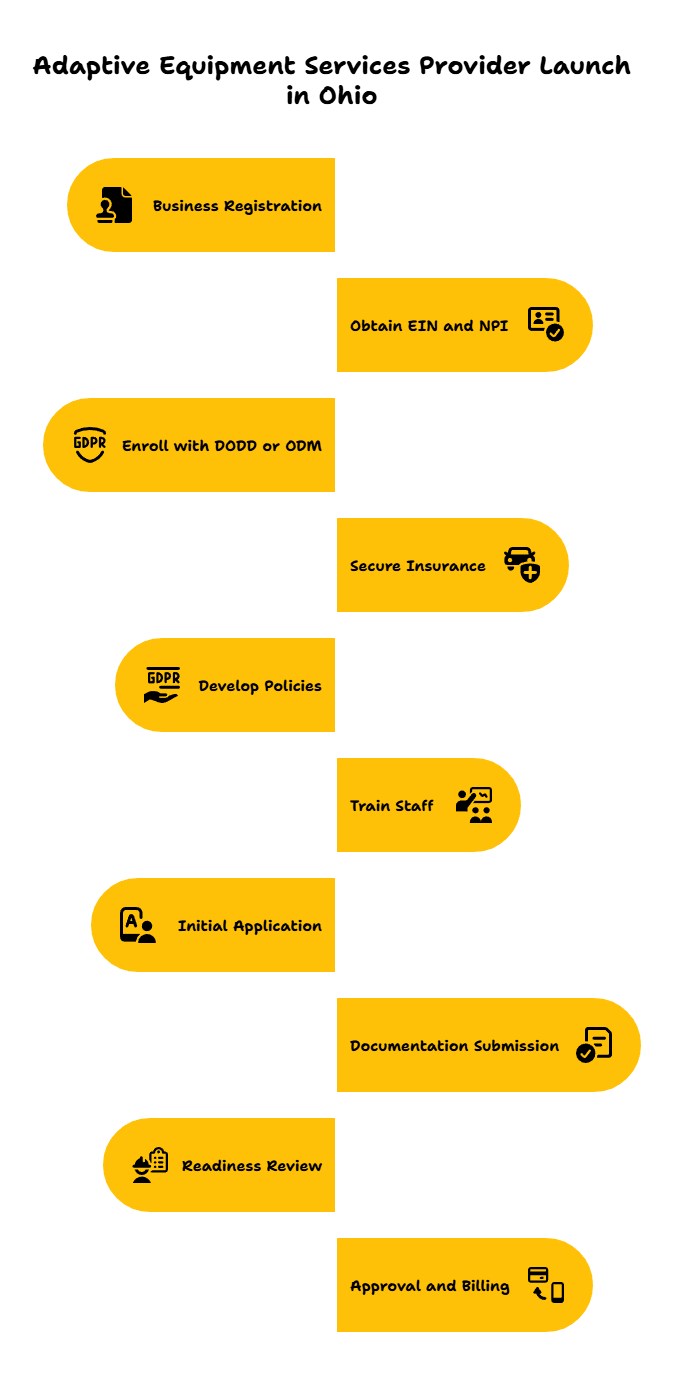
The path to becoming a Medicaid provider requires a rigorous commitment to documentation and operational readiness. Before applying, an entity must be properly registered with the Ohio Secretary of State and hold an EIN from the IRS. A Type 2 NPI is also required for billing purposes. Providers must maintain robust insurance coverage, including both general liability and product-specific liability, to protect both the business and the individuals served.
Beyond the business basics, prospective providers must develop comprehensive internal policies. These should cover every aspect of the equipment lifecycle: from procurement and inventory control to specific protocols for customization and on-site installation. Agencies must prove their ability to document services accurately and maintain records that satisfy both state and federal audit standards. Finally, ensure that all staff members are trained in equipment configuration and safety before they interact with any waiver participant.
How Does the Enrollment Process Work?
The enrollment process is sequenced to ensure that only qualified providers enter the Medicaid system. The initial phase involves selecting the correct enrollment portal based on the specific population to be served—generally the DODD Provider Certification Portal or the Ohio Medicaid Provider Enrollment system. Following the application, the provider must submit a portfolio of documentation, including business licenses, proof of insurance, evidence of vendor agreements, and detailed internal policies regarding equipment handling and staff training.
Once the initial application is submitted, state agencies will conduct a readiness review. This review assesses the provider’s operational maturity, confirming that the agency is truly prepared to deliver, install, and train on equipment while adhering to strict Medicaid billing standards. Upon successful completion of this review and subsequent approval, the provider is assigned a Medicaid billing number, marking the official authorization to begin delivering services and processing claims for reimbursement under applicable waivers.
How Should Staffing and Training Be Structured?
Staffing requirements for an adaptive equipment agency balance technical expertise with the ability to communicate effectively with individuals who have diverse needs. A Program Manager is essential; this role requires a strong background in rehabilitation technology, occupational therapy, or durable medical equipment (DME) management, alongside a deep understanding of Medicaid compliance. Equipment technicians must be properly trained in device safety, setup, and maintenance, and they must undergo consistent background checks.
All personnel, regardless of their specific technical role, must complete foundational training in ADA, HIPAA, and general Medicaid compliance. Additionally, staff should receive annual updates on new assistive technologies and best practices for supporting individuals with disabilities. Documentation is a critical component of every staff role; all team members must be trained on how to record evaluations, maintenance logs, and participant interactions in strict accordance with Medicaid standards.
Frequently Asked Questions
Which Medicaid waiver programs allow for Adaptive Equipment Services?
These services are available through several programs, including the Individual Options (IO) Waiver, the SELF Waiver, and the Level One Waiver for those with developmental disabilities. Additionally, older adults may access these services through the PASSPORT Waiver or the Ohio Home Care Waiver. Those with dual-eligibility may also receive these services through MyCare Ohio managed care plans.
What is the typical timeline to launch an adaptive equipment agency?
The process generally takes 6 to 10 months. This includes 1–2 months for business registration, 2–3 months for vendor sourcing and policy development, 60–90 days for Medicaid enrollment and state approval, and 30–45 days for final service activation and billing system setup.
What type of documentation must be kept for audits?
Providers must maintain organized records for every piece of equipment provided. This includes the initial assessment and recommendation, proof of purchase or procurement, equipment warranties, installation records, staff training logs, and specific Medicaid billing documentation. All participant consent forms, HIPAA privacy acknowledgments, and grievance records must also be archived for audit readiness.
Key Takeaway
Launching an Adaptive Equipment Services agency in Ohio is an intensive but highly rewarding process that requires meticulous attention to regulatory compliance, staff training, and equipment quality. By aligning business operations with the specific requirements of the ODM, DODD, and ODA, providers can successfully build a sustainable model that significantly improves the quality of life for Ohio's HCBS waiver participants. Maintaining a focus on documentation, person-centered outcomes, and ongoing technical education is the most effective way to ensure long-term success in the Ohio Medicaid landscape.
Last verified: 2024. This information is for educational purposes only and does not constitute legal or professional advice. Always consult the official websites of the Ohio Department of Medicaid, the Ohio Department of Developmental Disabilities, and the Centers for Medicare & Medicaid Services for the most current regulatory updates and requirements.