ADAPTIVE EQUIPMENT SERVICES PROVIDER IN NEW YORK
By Fatumata Kaba · 2025-09-04 · 6 min read
ENHANCING INDEPENDENCE AND MOBILITY THROUGH CUSTOMIZED ADAPTIVE EQUIPMENT SOLUTIONS
Adaptive Equipment Services in New York function as a critical component of the state’s Home and Community-Based Services (HCBS) waiver landscape, providing essential devices that enable individuals with disabilities to maintain independence and safety within their homes and communities. By focusing on the assessment, acquisition, customization, and ongoing maintenance of specialized technology, these services bridge the gap between clinical necessity and daily living requirements for thousands of New Yorkers. For provider agencies, entering this space requires a rigorous commitment to regulatory compliance, clinical precision, and the administrative standards set forth by the New York State Department of Health and its partner agencies.
How Do Governing Agencies Regulate Adaptive Equipment Services?
The regulatory framework for Adaptive Equipment Services in New York is multi-layered, designed to ensure that every piece of equipment delivered meets strict safety and efficacy standards. The New York State Department of Health (NYSDOH) serves as the primary authority, administering Medicaid waiver funding and overseeing the complex processes of provider enrollment, service authorization, and final reimbursement. Because these services are often integrated into specific populations, other state agencies provide additional layers of oversight and guidance.
The Office for People With Developmental Disabilities (OPWDD) and the New York State Office of Mental Health (OMH) act as essential partners, ensuring that adaptive equipment provided under their respective waivers is tailored to the unique behavioral and physical needs of their participants. Federally, the Centers for Medicare & Medicaid Services (CMS) provides the overarching mandate, ensuring that all Medicaid-funded services uphold person-centered care standards, maintain quality assurance, and adhere to federal civil rights requirements for accessibility and inclusion.
What Are the Core Responsibilities of an Adaptive Equipment Provider?
An approved provider’s role extends far beyond the mere delivery of hardware. The service cycle begins with a comprehensive needs assessment, where physical, mobility, and environmental barriers are identified. Based on these findings, providers must recommend specific adaptive devices that align with the participant’s functional goals and the clinical orders provided by their healthcare team. Success in this field is measured by the ability to customize off-the-shelf or bespoke equipment to ensure maximum usability and comfort for the end user.
Beyond initial acquisition, providers are responsible for the entire lifecycle of the equipment. This includes professional installation, detailed training for both the individual and their caregivers, and a proactive maintenance schedule to prevent safety failures. Providers must document every interaction, from the initial safety inspection to subsequent repair requests, ensuring that the participant's "equipment history" is always up to date and audit-ready.
- Needs Assessment: Identifying the individual’s physical, mobility, and environmental needs.
- Equipment Selection: Recommending appropriate adaptive devices based on assessment outcomes.
- Customization: Modifying equipment to ensure comfort, usability, and safety.
- Installation and Setup: Placing and configuring equipment within the individual’s home or community setting.
- Training and Education: Instructing individuals and caregivers on proper use and maintenance.
- Maintenance and Repair: Providing ongoing technical support and equipment repairs.
- Safety Inspections: Ensuring that adaptive devices remain safe and functional.
- Documentation: Maintaining records of assessments, equipment installations, and follow-up services.
What Are the Prerequisites for Licensure and Enrollment?
To operate as an Adaptive Equipment Services provider, an agency must establish a solid legal and financial foundation. This begins with formal registration of the business entity with the New York Department of State and the procurement of an Employer Identification Number (EIN) from the IRS. Furthermore, agencies must secure a Type 2 National Provider Identifier (NPI) to distinguish the organization as a corporate entity for billing purposes. Compliance is not merely a box-ticking exercise; it involves securing robust general and professional liability insurance policies that cover the inherent risks associated with equipment installation and potential device failure.
The enrollment process is facilitated through the eMedNY Provider Enrollment Portal. Prospective agencies must be prepared to submit comprehensive policy manuals that detail their protocols for assessment, installation, and ongoing maintenance. Additionally, all agency staff must undergo rigorous background checks and mandatory health screenings. Agencies are expected to have a well-documented human resources policy that ensures all personnel possess the necessary credentials, training, and competency to handle specialized adaptive hardware in diverse residential settings.
How Is the Provider Enrollment Process Structured?
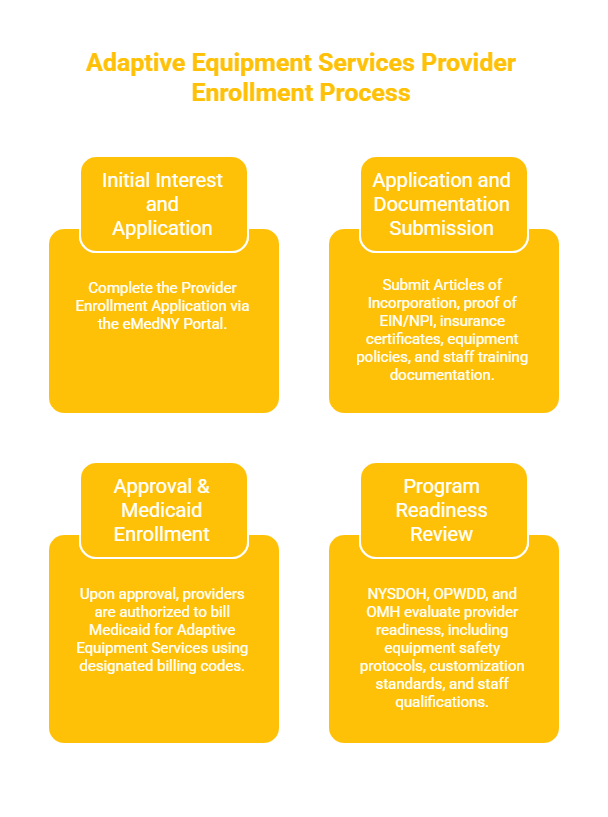
The transition from a business entity to an active Medicaid provider occurs in several distinct phases. First, an agency must express interest through the eMedNY portal and submit the initial application package. This phase requires the submission of foundational documents, including Articles of Incorporation, proof of EIN, NPI documentation, and detailed insurance certificates. The thoroughness of the submitted Policy & Procedure Manual is often the deciding factor in how quickly an agency moves toward approval.
Following the document submission, NYSDOH, OPWDD, or OMH will conduct a Program Readiness Review. This critical step evaluates whether the provider possesses the technical capacity to deliver services safely. Evaluators may review staff training logs, safety protocols for custom fabrication, and the agency’s internal quality assurance procedures. Only after this rigorous review is the provider granted authorization to bill Medicaid using the specific procedure codes designated for the waiver programs they serve.
What Are the Essential Staffing and Competency Requirements?
Qualified personnel are the backbone of a compliant Adaptive Equipment Service agency. Leadership typically requires an Adaptive Equipment Program Director, who holds a degree in a relevant field such as biomedical engineering, rehabilitation technology, or healthcare administration. This individual is responsible for overseeing the program's strategic direction and ensuring adherence to state regulations. Below them, Adaptive Equipment Specialists must bring specific certifications in assistive technology to ensure that the equipment selected is clinically appropriate.
Maintenance Technicians must possess the technical skills required for the physical repair and safety testing of various mobility and assistive devices. Regardless of the role, every staff member must complete standardized training modules covering HIPAA compliance, the rights of the participants they serve, and specific protocols for safety and emergency response. Ongoing professional development is a standard expectation, requiring that staff attend regular training sessions to stay current with advancements in adaptive technology and evolving state compliance standards.
Frequently Asked Questions
What waivers in New York cover Adaptive Equipment Services?
These services are covered under several key programs, including the OPWDD Comprehensive Waiver, the Home and Community-Based Services (HCBS) Waiver, the Nursing Home Transition and Diversion (NHTD) Waiver, the Traumatic Brain Injury (TBI) Waiver, and the Children’s Waiver.
How long should a new agency expect the launch process to take?
While timelines vary based on individual agency readiness, the process generally spans several months: 1–2 months for business formation, 2–3 months for staffing and program development, 60–90 days for Medicaid enrollment and readiness reviews, and 30–45 days for final billing setup and service launch.
What must be included in the Adaptive Equipment Policy & Procedure Manual?
The manual must comprehensively cover equipment selection and assessment protocols, installation and safety inspection procedures, staff training and credentialing records, HIPAA and privacy compliance, and clear documentation standards for service tracking, billing, and grievance handling.
Key Takeaway
Launching an Adaptive Equipment Service agency in New York requires a disciplined approach to both technical equipment standards and Medicaid administrative compliance. By focusing on robust policy development, specialized staffing, and careful adherence to the requirements of the NYSDOH and partner agencies, providers can effectively navigate the enrollment process and contribute to the health and independence of New York’s waiver participants.
Last verified: October 2023. Disclaimer: This article is for informational purposes only and does not constitute legal or professional advice. Always refer to the latest guidance from the New York State Department of Health and official eMedNY documentation when establishing your program.