ADAPTIVE EQUIPMENT SERVICES PROVIDER IN NEW JERSEY
By Fatumata Kaba · 2025-09-05 · 6 min read
Adaptive Equipment Services in New Jersey provide individuals with disabilities, chronic conditions, or mobility challenges the essential tools and devices required to maintain independence and enhance their quality of life. Authorized under various New Jersey Medicaid Home and Community-Based Services (HCBS) waiver programs, these services encompass the professional assessment, procurement, customization, installation, and ongoing maintenance of specialized equipment tailored to each participant's unique functional needs.
For healthcare agencies and entrepreneurs looking to enter this sector, becoming an approved provider requires a rigorous commitment to person-centered planning and regulatory compliance. By aligning business operations with the standards set by the Department of Human Services (DHS) and the Division of Developmental Disabilities (DDD), providers play a critical role in the Medicaid service delivery ecosystem, ensuring participants have the secure, reliable, and effective equipment necessary to thrive in their homes and communities.
Who Governs Adaptive Equipment Services in New Jersey?
The delivery of Adaptive Equipment Services is governed by a multi-tiered regulatory framework designed to ensure participant safety and fiscal accountability. At the state level, the New Jersey Department of Human Services (DHS) serves as the primary administrative body. DHS manages the overarching Medicaid waiver funding, oversees the provider enrollment process, establishes service authorization protocols, and coordinates reimbursement schedules to ensure services are delivered consistently across the state.
Within DHS, the Division of Developmental Disabilities (DDD) holds direct responsibility for monitoring service delivery quality and ensuring provider compliance with HCBS waiver standards. Providers must operate in strict accordance with both state-specific mandates and federal oversight provided by the Centers for Medicare & Medicaid Services (CMS). CMS ensures that all Medicaid-funded adaptive equipment programs adhere to federal person-centered planning requirements and participant protection standards, emphasizing the individual's right to choose their equipment and service providers.
What Are the Core Components of Adaptive Equipment Service Delivery?
Approved providers are responsible for a comprehensive service lifecycle that begins with clinical necessity and ends with long-term maintenance. Services are not "one size fits all"; they must be delivered in strict accordance with the participant’s Individualized Service Plan (ISP). This ensures that the equipment procured truly addresses the functional deficits identified by the participant’s care team, facilitating greater autonomy in daily activities.
Providers generally offer a suite of specialized interventions, including:
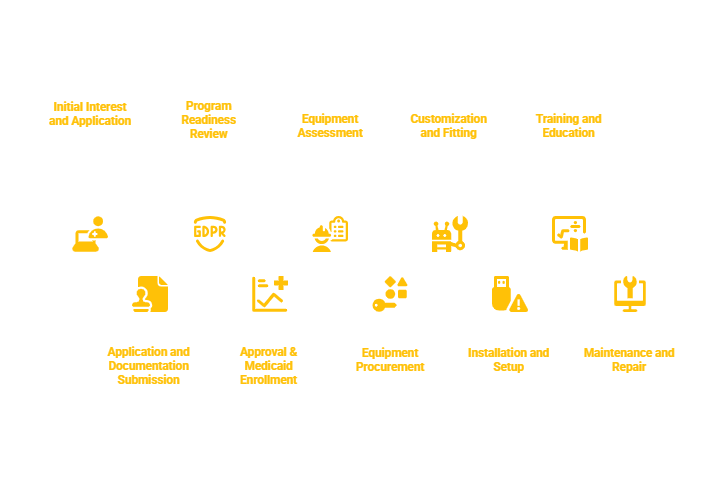
- Equipment Assessment: Conducting functional evaluations to determine the exact requirements of the participant.
- Equipment Procurement: Sourcing high-quality mobility aids, communication devices, and adaptive tools.
- Customization and Fitting: Modifying equipment to ensure it meets the specific physical or anatomical needs of the user.
- Installation and Setup: Ensuring that hardware, such as transfer devices or home adaptations, is installed safely and follows all building and safety codes.
- Training and Education: Providing comprehensive instruction to the participant and their caregivers on the proper operation, safety protocols, and daily care of the equipment.
- Maintenance and Repair: Providing ongoing support to ensure that equipment remains safe, functional, and reliable over time.
What Are the Essential Prerequisites for Provider Enrollment?
Transitioning into an authorized Medicaid provider requires significant administrative groundwork. Before applying for enrollment, a business entity must be properly registered with the New Jersey Division of Revenue and Enterprise Services. This foundational step is followed by obtaining an Employer Identification Number (EIN) from the IRS and a Type 2 National Provider Identifier (NPI) to facilitate accurate billing within the Medicaid system.
Beyond basic business registration, agencies must demonstrate operational readiness. This involves securing necessary professional and general liability insurance, as well as obtaining any specialized certifications required for the specific equipment they intend to provide. Agencies must also develop robust internal policy manuals that outline comprehensive protocols for equipment assessment, installation safety, and ongoing device maintenance. Furthermore, every staff member must undergo rigorous background checks and health screenings to meet the high-security standards mandated for those working with vulnerable populations.
Key operational documents to have prepared include:
- Articles of Incorporation or official Business License documentation.
- Comprehensive Policy & Procedure Manual addressing HIPAA compliance and grievance handling.
- Detailed staff credentialing records, including certifications for assistive technology professionals.
- Documented quality assurance and compliance monitoring systems.
How Does the Medicaid Provider Enrollment Process Function?
The enrollment process is a structured, sequential journey that requires meticulous attention to detail. Initially, the applicant must submit a formal request via the New Jersey Medicaid Provider Enrollment Portal. This application serves as the primary data point for state reviewers to assess the agency's capacity to deliver HCBS-authorized services. Following the submission, agencies must provide all supporting documentation, including their business certifications, insurance binders, and policy manuals.
Once the paperwork is reviewed, the state conducts a program readiness review. During this phase, representatives from DHS and DDD evaluate the provider’s operational infrastructure, specifically looking for evidence that the agency can perform safe installations and maintain rigorous safety protocols. Upon the successful completion of this review and final approval, the provider is officially authorized to deliver services and utilize designated billing codes to request Medicaid reimbursement for equipment and support services rendered.
What Are the Mandatory Staffing and Training Requirements?
Successful agencies rely on a blend of administrative oversight and technical expertise. The Adaptive Equipment Program Director is the cornerstone of the operation, typically requiring a Bachelor’s degree in healthcare administration, rehabilitation technology, or a related field, along with a proven background in adaptive equipment management. This individual is responsible for ensuring the entire organization meets state compliance standards.
Direct service delivery is usually handled by Assistive Technology Specialists and Support Technicians. These roles require specialized technical training and, in the case of specialists, professional certifications such as the Assistive Technology Professional (ATP) credential. All staff members are required to engage in continuous learning, which includes:
- Regular training in equipment installation safety and ergonomic fitting.
- Mandatory HIPAA compliance and participant rights education.
- Ongoing professional development and manufacturer-specific equipment certifications.
- Annual competency evaluations and safety protocol refreshers.
Frequently Asked Questions
Which Medicaid Waivers cover Adaptive Equipment Services?
Adaptive Equipment Services are available under several New Jersey Medicaid Waivers, including the Community Care Program for the Elderly and Disabled (CCPED), the Supports Program Waiver, the Acquired Brain Injury (ABI) Waiver, the Personal Care Assistant (PCA) Waiver, and the general Home and Community-Based Services (HCBS) Waiver.
How long does the launch process generally take?
The timeline varies based on organizational readiness, but the full lifecycle—from business formation to launching Medicaid billing—typically spans 6 to 10 months. This includes 1–2 months for business formation, 2–3 months for staffing and internal development, 60–90 days for Medicaid enrollment and readiness review, and 30–45 days for final billing system setup.
What must be included in the Adaptive Equipment Service Policy Manual?
The manual must detail your agency’s specific procedures for needs assessment, equipment selection, installation, and safety checks. It must also include sections on staff credentialing, HIPAA privacy, participant grievance handling, documentation standards for Medicaid billing, and quality assurance protocols for ongoing maintenance.
Key Takeaway
Launching an Adaptive Equipment Services agency in New Jersey requires a strategic integration of clinical expertise and administrative rigor. Success is predicated on adhering to the specific directives of the DHS and DDD while maintaining a person-centered approach that prioritizes the safety and independence of the waiver participant. By systematically organizing business operations, credentialing staff, and perfecting the enrollment workflow, providers can establish a sustainable and compliant agency capable of delivering vital adaptive solutions to the community.
Last verified: 2024. This article is provided for informational purposes only and does not constitute legal or professional licensing advice. Please consult directly with the New Jersey Department of Human Services (DHS) or the Division of Developmental Disabilities (DDD) for the most current regulatory guidance and to verify specific requirements for your agency's unique circumstances.