ADAPTIVE EQUIPMENT SERVICES PROVIDER IN NEVADA
By Fatumata Kaba · 2025-09-04 · 5 min read
ENHANCING MOBILITY AND INDEPENDENCE THROUGH CUSTOMIZED EQUIPMENT SOLUTIONS
Adaptive Equipment Services in Nevada provide essential devices and technologies that empower individuals with disabilities or mobility challenges to live more independently within their own homes and communities. By focusing on the assessment, procurement, installation, and ongoing maintenance of specialized devices, these services directly support the objectives of Nevada Medicaid Home and Community-Based Services (HCBS) waiver programs to improve safety, accessibility, and overall quality of life for participants.
What Are the Governing Agencies and Regulatory Frameworks?
The delivery of adaptive equipment is governed by a multi-tiered regulatory structure designed to ensure patient safety and fiscal accountability. At the state level, the Nevada Department of Health and Human Services (DHHS) serves as the primary administrator, managing Medicaid waiver funding, overseeing the provider enrollment process, and establishing reimbursement policies for approved services.
Working in conjunction with DHHS, the Aging and Disability Services Division (ADSD) is responsible for the operational oversight of these services. ADSD ensures that providers maintain high-quality service standards, adhere to established delivery protocols, and remain in full compliance with the specific requirements of HCBS waiver programs. Additionally, the federal Centers for Medicare & Medicaid Services (CMS) provides overarching federal guidance, ensuring that all Medicaid-funded services uphold national standards for person-centered planning, participant protection, and equitable access to care.
How Are Adaptive Equipment Services Structured and Delivered?
Adaptive Equipment Services are defined by their ability to provide custom-tailored solutions based on the unique functional needs of the participant. Approved providers are tasked with a comprehensive scope of work that goes beyond simple equipment delivery, requiring a professional, hands-on approach to enhancing a participant's living environment.
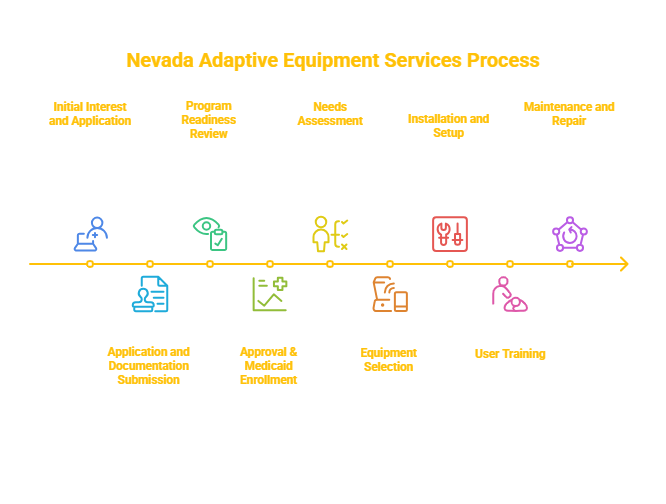
Providers generally deliver the following core services in accordance with an individual's Individualized Service Plan (ISP):
- Needs Assessment: Conducting formal evaluations of the participant’s functional environment to identify specific barriers to independence.
- Equipment Selection and Installation: Identifying and securing appropriate devices such as mobility aids, lifts, and communication tools, followed by professional installation that meets safety codes.
- User and Caregiver Training: Educating the participant and their primary caregivers on the safe operation, daily management, and routine troubleshooting of the equipment.
- Maintenance and Repair: Providing long-term technical support to ensure devices remain in working order and safe for continued use.
- Home Modifications: Installing accessibility features such as ramps, grab bars, and specialized fixtures that allow for safer home navigation.
What Are the Licensing and Provider Approval Requirements?
Establishing an agency to provide Adaptive Equipment Services in Nevada requires rigorous adherence to state and federal prerequisites. Before an entity can begin billing for services, it must establish a formal business structure, secure necessary tax identifiers, and prove its capability to deliver high-quality, safe, and compliant equipment solutions.
Prospective providers must complete several foundational steps:
- Register the business entity with the Nevada Secretary of State.
- Obtain a Federal Employer Identification Number (EIN) and a Type 2 National Provider Identifier (NPI).
- Enroll as a Medicaid Waiver Adaptive Equipment provider through the Nevada Medicaid Provider Enrollment Portal.
- Obtain required certifications for specific adaptive equipment installation and maintenance tasks.
- Maintain adequate levels of general and professional liability insurance to protect both the agency and the participants.
- Develop comprehensive written policies covering assessment, installation, safety protocols, and equipment maintenance.
What Is the Step-by-Step Nevada Provider Enrollment Process?
The enrollment process is designed to vet providers thoroughly to ensure that only qualified organizations are permitted to serve vulnerable populations. This process is structured to verify that the provider’s business model aligns with the safety and quality expectations of the DHHS and ADSD.
The journey to authorization follows a standardized path:
- Application Submission: Agencies begin by submitting a formal Provider Enrollment Application through the Nevada Medicaid Provider Enrollment Portal, ensuring all organizational documentation—such as Articles of Incorporation and NPI confirmation—is current and accurate.
- Readiness Review: Following the initial submission, state agencies (DHHS and ADSD) conduct a program readiness review. This phase evaluates the provider’s operational readiness, including the safety of their installation procedures and the adequacy of their staff qualification frameworks.
- Approval and Billing Setup: Once the readiness review is successfully completed, the provider is officially enrolled in the Medicaid system. This authorization grants the provider the ability to begin billing for approved services using specific Medicaid-coded procedures.
How Are Staffing and Operational Standards Maintained?
Staffing requirements are a critical component of agency compliance. Because adaptive equipment directly impacts the physical safety of participants, providers must employ personnel who are not only technically proficient but also vetted through background checks and health screenings. The organizational hierarchy typically requires an Adaptive Equipment Program Director, who oversees administrative compliance and service delivery, supported by specialized technicians.
All staff members, regardless of their role, are subject to ongoing training requirements, including:
- Mandatory education on HIPAA compliance, patient rights, and the ethical handling of sensitive information.
- Technical certification training specific to the types of adaptive equipment and mobility aids being installed.
- Regular competency evaluations and safety protocol refreshers to ensure that every installation meets the highest quality assurance standards.
- Annual background check updates to ensure the continued safety of the participants being served.
Frequently Asked Questions
Which Medicaid waiver programs cover Adaptive Equipment Services in Nevada?
Adaptive Equipment Services are integrated into several key Nevada Medicaid waivers, including the Home and Community-Based Waiver for Persons with Intellectual and Developmental Disabilities (HCBS-IDD), the Frail Elderly (FE) Waiver, the Physical Disabilities Waiver, the Traumatic Brain Injury (TBI) Waiver, and the Aged and Disabled (AD) Waiver.
What is the typical timeline for launching an Adaptive Equipment agency?
While timelines vary based on business preparation, the process generally takes approximately 6 to 9 months. This includes 1–2 months for business formation, 2–3 months for staffing and program development, 60–90 days for the Medicaid enrollment and readiness review, and 30–45 days for final billing setup.
What documentation is required during the Medicaid provider enrollment process?
Applicants must provide proof of legal business existence, such as a Nevada Secretary of State business license, EIN and NPI documentation, professional certifications for staff, and proof of required insurance. Additionally, a comprehensive policy and procedure manual detailing everything from equipment installation protocols to grievance procedures must be ready for review.
WAIVER CONSULTING GROUP’S START-UP ASSISTANCE SERVICE — NEVADA ADAPTIVE EQUIPMENT SERVICES PROVIDER
WCG supports healthcare agencies and adaptive technology providers in launching Medicaid-compliant Adaptive Equipment Services in Nevada, offering support for business registration, Medicaid enrollment, policy manual development, staff credentialing, and quality assurance systems to ensure long-term operational success.
Key Takeaway: Successfully launching an Adaptive Equipment Service provider in Nevada requires a rigorous commitment to state-mandated clinical and administrative protocols. By focusing on compliant documentation, specialized staff training, and a participant-centered approach to device selection and installation, providers can effectively bridge the gap between physical limitations and independent living within Nevada’s Medicaid HCBS framework.
Last verified: October 2023. Disclaimer: This article is intended for informational purposes only and does not constitute legal or professional advice. Requirements for Medicaid providers may change; always consult the latest guidance from the Nevada Department of Health and Human Services (DHHS) and the Aging and Disability Services Division (ADSD) before making business decisions.