ADAPTIVE EQUIPMENT SERVICES PROVIDER IN MASSACHUSETTS
By Fatumata Kaba · 2025-08-07 · 5 min read
Adaptive equipment services in Massachusetts are essential clinical and support programs designed to provide individuals with disabilities the specialized tools required to maintain independence, safety, and functional autonomy within their homes and communities. These services encompass the professional assessment, procurement, customized fitting, and ongoing maintenance of devices that mitigate the impact of physical or developmental impairments, ensuring individuals can successfully navigate their daily living environments.
For healthcare providers and business owners, becoming an authorized adaptive equipment service provider involves navigating a complex landscape of state and federal regulations. This process requires precise adherence to MassHealth and Home and Community-Based Services (HCBS) waiver requirements, ensuring that all equipment delivered meets the rigorous standards mandated for medical necessity and patient safety.
What Are the Governing Agencies and Regulatory Frameworks?
The provision of adaptive equipment in Massachusetts operates under a multi-agency oversight structure. MassHealth (Medicaid) serves as the primary payer, authorizing and reimbursing equipment through both standard Durable Medical Equipment (DME) benefits and specific HCBS waiver policies. The Executive Office of Health and Human Services (EOHHS) maintains executive oversight of these services, ensuring that statewide policies align with the federal guidelines set forth by the Centers for Medicare & Medicaid Services (CMS).
In addition to MassHealth, two state departments play critical roles in service coordination: the Massachusetts Rehabilitation Commission (MRC) and the Department of Developmental Services (DDS). The MRC provides vital support for non-Medicaid participants who require adaptive technologies, while the DDS manages the referral and funding process for individuals with intellectual or developmental disabilities. Understanding the distinct jurisdictional requirements of each agency is the first step in establishing a sustainable service model.
What Constitutes Qualified Adaptive Equipment?
Adaptive equipment serves a broad spectrum of clinical needs, ranging from mobility support to complex communication requirements. To be eligible for reimbursement, every piece of equipment must be deemed medically necessary and formally documented in the individual’s Plan of Care (POC) or Individual Support Plan (ISP). These tools must directly enhance an individual’s ability to perform activities of daily living (ADLs) or prevent institutionalization.
Typical categories of adaptive equipment include:
- Manual or power wheelchairs, scooters, and related mobility bases
- Augmentative and Alternative Communication (AAC) devices and speech boards
- Hospital-grade beds, specialized mattresses, and safety bed rails
- Adaptive daily living aids such as customized utensils, dressing tools, and toileting equipment
- Patient transfer systems, including lifts, slings, and fall prevention sensors
- Sensory assistance technology, including hearing and visual aid devices
- Customized environmental control units and equipment mounting systems
How Do Providers Successfully Enroll and Maintain Compliance?
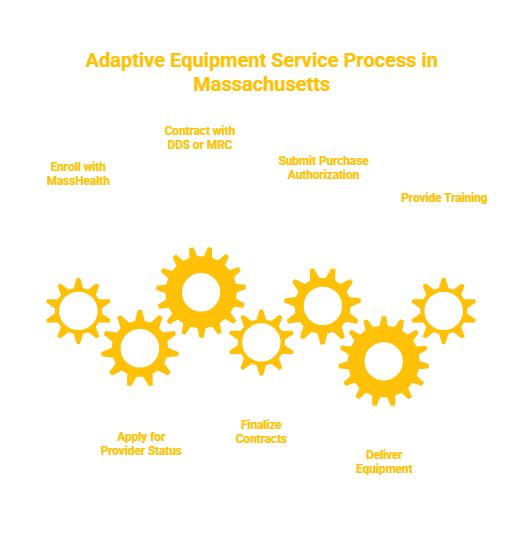
The provider enrollment process is a sequential journey that begins with establishing the business entity. Providers must register with the Massachusetts Secretary of the Commonwealth, obtain an IRS Employer Identification Number (EIN), and secure a Type 2 National Provider Identifier (NPI). Following these administrative filings, the entity must secure comprehensive insurance coverage, including general liability and product liability policies specifically tailored for medical equipment providers.
Once registered, providers must engage with the MassHealth Provider Online Service Center (POSC) to enroll as a DME provider. Beyond the basic enrollment, providers aiming to serve HCBS populations must seek additional authorization to bill for waiver-funded services. This requires submitting detailed documentation regarding staff qualifications—specifically ensuring that personnel include certified Assistive Technology Professionals (ATP) or licensed therapists—and providing evidence of rigorous quality control policies for equipment maintenance, warranty management, and HIPAA-compliant record keeping.
What Are the Essential Staffing and Clinical Requirements?
Qualified staffing is a prerequisite for providing high-quality adaptive equipment services. Because these devices often involve complex mechanical or electronic interfaces, providers must employ or contract with specialized personnel. The Assistive Technology Professional (ATP) is the cornerstone of these services, responsible for complex evaluations and ensuring that equipment matches the specific clinical needs of the participant. It is recommended that these professionals maintain RESNA certification or possess equivalent verified experience.
The clinical and operational team must also be supported by:
- Equipment Delivery Technicians: Staff trained in the precise assembly, safety testing, and on-site fitting of equipment to ensure user safety.
- OT/PT Consultants: Licensed occupational or physical therapists who can perform detailed assessments and clinical justifications for specialized equipment.
- Mandatory Training Personnel: Staff must regularly participate in training covering ADA compliance, infection control and sanitation, and person-centered service delivery models to remain in audit readiness.
Frequently Asked Questions
What is the difference between DME benefits and HCBS waiver-funded equipment?
DME benefits are generally managed under standard MassHealth state plan services and focus on standard medical necessities. HCBS waiver-funded equipment, conversely, is often broader in scope and designed specifically to help individuals remain in their own homes, sometimes covering customized modifications or specialized tools not found in standard DME catalogs.
Is an ATP certification mandatory for all providers?
While requirements can vary based on the specific contract and the type of equipment provided, the use of an ATP or a licensed clinician is highly encouraged and often mandated by state agencies to ensure that assessments, fittings, and equipment customizations meet the high standard of care required by CMS and Massachusetts state regulations.
How long should a provider expect the enrollment process to take?
The timeline varies depending on the provider's readiness. Generally, business registration and insurance procurement take two to three weeks, while MassHealth and waiver provider enrollment can take one to two months. Developing a compliant Policy & Procedure Manual and credentialing staff usually requires four to six weeks of dedicated administrative time.
WAIVER CONSULTING GROUP’S START-UP ASSISTANCE SERVICE — MASSACHUSETTS ADAPTIVE EQUIPMENT PROVIDER
WCG supports DME businesses, rehabilitation therapists, and equipment installers in launching adaptive equipment services for Medicaid-eligible individuals across Massachusetts. Our expertise covers the full spectrum of operational setup, including business and Medicaid/DME provider registration, DDS/MRC waiver enrollment, creation of comprehensive Policy & Procedure Manuals, and the development of audit-ready compliance systems for equipment fulfillment and billing.
Key Takeaway: Establishing a successful adaptive equipment business in Massachusetts requires a rigorous balance of clinical expertise, administrative precision, and unwavering compliance with state-specific regulations. Providers who invest in robust documentation, qualified staff, and standardized operational workflows are best positioned to serve the needs of the Medicaid population while maintaining long-term financial and regulatory stability.
Last verified: October 2023. This content is provided for informational purposes only and does not constitute legal or professional advice. Always refer to the official MassHealth Provider Manuals and relevant state agency regulations for the most current guidance on program requirements and billing compliance.