ADAPTIVE EQUIPMENT SERVICES PROVIDER IN INDIANA
By Watchen Roberts · 2025-07-21 · 5 min read
ENHANCING INDEPENDENCE, MOBILITY, AND QUALITY OF LIFE THROUGH CUSTOMIZED EQUIPMENT SOLUTIONS
Adaptive Equipment Services in Indiana represent a vital pillar of the state's Home and Community-Based Services (HCBS) framework, designed to provide specialized devices that empower individuals with disabilities or chronic health conditions. By facilitating access to mobility aids, communication devices, and environmental controls, these services ensure that participants can maintain their independence and participate fully in their communities, all while adhering to stringent Medicaid standards for medical necessity and participant-centered care.
Understanding the Regulatory Oversight of Adaptive Equipment
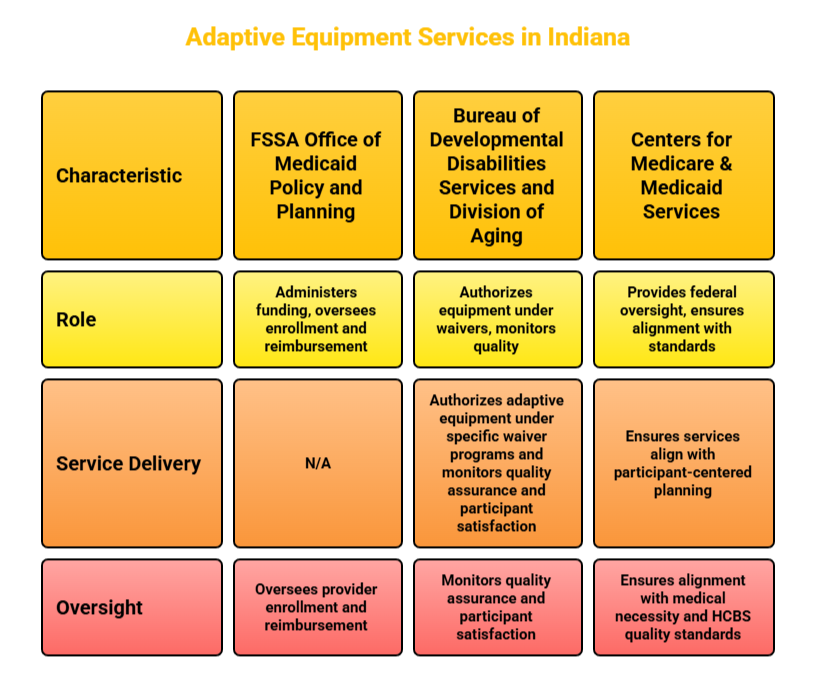
The delivery of adaptive equipment in Indiana is governed by a multi-layered regulatory structure that ensures every piece of equipment provided is safe, effective, and clinically justified. At the state level, the Indiana Family and Social Services Administration (FSSA) through the Office of Medicaid Policy and Planning (OMPP) serves as the primary authority, managing Medicaid funding, provider enrollment, and the critical reimbursement pathways necessary for financial sustainability.
Operational oversight is delegated to the Bureau of Developmental Disabilities Services (BDDS) and the Division of Aging. These entities are responsible for authorizing specific equipment within the context of individual waiver programs and monitoring the quality of care provided to participants. Furthermore, these state efforts operate under the federal umbrella of the Centers for Medicare & Medicaid Services (CMS), which mandates that all services align with federal HCBS quality standards and person-centered planning requirements.
Scope of Services and Equipment Categories
Adaptive Equipment Services encompass the entire lifecycle of a medical device, from the initial professional assessment to the final fitting, procurement, training, and ongoing maintenance. The core objective is to utilize technology to increase or maintain a participant’s functional capabilities, allowing them to remain in their own homes rather than transitioning to institutional care settings.
Providers authorized under Indiana Medicaid waiver programs are expected to deliver a diverse range of support, including:
- Mobility aids such as manual and powered wheelchairs, scooters, and specialized walkers.
- Communication devices including speech-generating systems and adaptive keyboards.
- Environmental control systems featuring automated doors, lighting control, and adaptive switches.
- Self-care aids like adaptive utensils, dressing devices, and custom transfer equipment.
- Specialized positioning equipment such as standers, bath chairs, and custom seating configurations.
- Sensory aids designed to support individuals with vision or hearing impairments.
Requirements for Provider Enrollment and Licensing
Launching an Adaptive Equipment Services agency requires a rigorous adherence to administrative and operational prerequisites. Before seeking enrollment, an organization must legally establish itself as a business entity with the Indiana Secretary of State and secure both an Employer Identification Number (EIN) from the IRS and a Type 2 National Provider Identifier (NPI). Depending on the nature of the equipment provided, entities may also need to secure specific Durable Medical Equipment (DME) supplier registration.
Beyond basic business filings, prospective providers must demonstrate operational readiness. This involves developing a comprehensive policy and procedure manual that covers the entire service delivery model. Insurance requirements, specifically maintaining adequate general liability and professional liability coverage, are mandatory to protect both the agency and the participants. The enrollment process culminates in a Program Readiness Review conducted by the FSSA, where the state assesses the provider's capacity for compliance, billing accuracy, and participant protection.
Staffing Standards and Competency Requirements
The efficacy of adaptive equipment relies heavily on the expertise of the staff providing the services. Agencies must maintain a structured team, beginning with an Adaptive Equipment Program Director or Supervisor. This individual must possess a background in healthcare management, assistive technology, or rehabilitation services and must pass all mandatory state background screenings. Their role is to ensure the agency’s policies are implemented consistently and that all services meet Medicaid requirements.
Direct service delivery often involves Adaptive Equipment Technicians who handle fitting and minor repairs, as well as Licensed Clinical Assessors for complex cases. These assessors must be licensed as Occupational Therapists (OT), Physical Therapists (PT), Speech-Language Pathologists (SLP), or Rehabilitation Engineers. To ensure participant safety, all staff—regardless of their specific role—must undergo regular training in HIPAA compliance, incident reporting, abuse prevention, and the correct usage of assistive technologies.
Navigating Medicaid Waiver Programs and Timelines
Adaptive Equipment Services are integrated into four primary Indiana Medicaid waivers: the Community Integration and Habilitation (CIH) Waiver, the Family Supports Waiver (FSW), the Aged and Disabled (A&D) Waiver, and the Traumatic Brain Injury (TBI) Waiver. Each of these programs requires that the equipment provided be explicitly identified as medically necessary within the participant’s Individualized Service Plan (ISP) or Plan of Care (POC). Providers must remain vigilant in documenting the medical necessity of every item supplied to ensure successful claim reimbursement.
The timeline to launch such a program is substantial, typically spanning several months of dedicated preparation. The process begins with business formation and licensing, which takes 1–2 months, followed by a 2–3 month period for hiring and program development. Formal enrollment and the state's readiness review take approximately 60–90 days, with final billing setup often requiring an additional 30–45 days. Proper project management is essential to ensure these phases remain on track.
Frequently Asked Questions
What documentation is required for a new provider applicant?
Applicants must provide articles of incorporation, an EIN/NPI, documentation of professional and general liability insurance, and any applicable DME licenses. Furthermore, an extensive policy and procedure manual covering intake, assessment, procurement, maintenance, and HIPAA compliance is necessary to pass the FSSA readiness review.
How is the medical necessity of equipment determined?
Medical necessity is established through a clinical assessment—often performed by a licensed OT, PT, or SLP—that links the specific piece of equipment to the functional deficits identified in the participant’s Individualized Service Plan. This documentation serves as the primary evidence during audits to justify the provision and funding of the equipment.
What are the primary responsibilities regarding equipment maintenance?
Providers are responsible for the entire maintenance cycle. This includes not only the initial installation and fitting but also established protocols for the repair and long-term upkeep of the device. Agencies must maintain detailed logs of equipment usage, repair history, and participant training to remain compliant with state quality assurance standards.
Key Takeaway: Successfully operating as an Adaptive Equipment Services provider in Indiana necessitates a dual commitment to technical proficiency in assistive technology and strict administrative compliance with Medicaid’s regulatory framework. By maintaining rigorous documentation, employing qualified clinical professionals, and adhering to the guidelines set forth by the FSSA and CMS, providers can ensure the delivery of high-quality, life-enhancing equipment to Indiana’s most vulnerable populations.
Last verified: 2024. The information provided is for educational purposes only and does not constitute legal or professional advice. Always refer to the official Indiana Family and Social Services Administration (FSSA) and Centers for Medicare & Medicaid Services (CMS) websites for the most current regulatory updates and program requirements.