ADAPTIVE EQUIPMENT SERVICES PROVIDER IN IDAHO
By Fatumata Kaba · 2025-07-17 · 6 min read
Becoming an Adaptive Equipment Services provider in Idaho is a vital step toward supporting the health, safety, and independence of individuals enrolled in the state’s Home and Community-Based Services (HCBS) waiver programs. This specialized role involves the assessment, acquisition, and maintenance of assistive technologies that empower participants to remain in their homes and communities, and it requires strict adherence to Idaho Department of Health and Welfare (IDHW) and federal Medicaid standards.
For entrepreneurs and established healthcare organizations, entering this service sector requires a deep understanding of provider enrollment, clinical documentation standards, and ongoing compliance. By aligning business operations with the regulatory framework governing these waivers, agencies can effectively deliver life-enhancing equipment while ensuring long-term sustainability within the Idaho Medicaid landscape.
What Are the Governing Agencies and Regulatory Standards for Adaptive Equipment?
The delivery of Adaptive Equipment Services is governed by a multi-tiered regulatory structure designed to protect participants and ensure the quality of care. The Idaho Department of Health and Welfare (IDHW) serves as the primary authority, overseeing provider enrollment, service authorization, and the reimbursement process. All providers must operate within the parameters set by the IDHW Division of Medicaid to maintain their status as an approved vendor.
In addition to state-level oversight, providers must work in coordination with the Idaho Assistive Technology Project (IATP), which provides essential resources and guidance on the latest technological advancements in the field. Finally, at the federal level, the Centers for Medicare & Medicaid Services (CMS) provides the overarching federal standards that dictate how HCBS waivers must be implemented to support functional independence and health outcomes.
Which Services Fall Under the Scope of Adaptive Equipment Programs?
Adaptive Equipment Services are defined by their capacity to help a participant overcome functional limitations that would otherwise hinder their daily activities. These services are not one-size-fits-all; they are highly customized based on clinical assessments and the unique goals outlined in a participant’s Individualized Service Plan (ISP). Providers are responsible for the full lifecycle of the equipment, from the initial recommendation to the final disposal or replacement.
Approved providers generally deliver a comprehensive suite of support services including:
- Conducting functional assessments and professional recommendations for specific devices.
- Managing the acquisition and customization of mobility devices such as wheelchairs and walkers.
- Providing installation and technical training for communication aids and speech-generating devices.
- Setting up environmental control units, such as adapted switches and smart home integration systems.
- Supplying and fitting daily living aids like grab bars, adaptive utensils, and grooming equipment.
- Performing ongoing maintenance, repairs, and necessary equipment replacements.
What Are the Essential Requirements for Provider Enrollment?
Launching a service provider agency requires meticulous attention to business and clinical infrastructure. Before a provider can begin billing, they must establish their business as a legal entity registered with the Idaho Secretary of State and secure a federal EIN, along with a Type 2 National Provider Identifier (NPI). This foundational work ensures that the business is recognized by federal and state tax and healthcare authorities.
Beyond legal formation, agencies must demonstrate that they possess the necessary insurance and internal protocols to protect both the agency and the participant. A robust operational model includes general and product liability insurance, as well as clear policies regarding intake, clinical selection of equipment, participant training, and the management of emergency repair requests. These documents serve as the backbone of an agency’s readiness for audit and compliance checks.
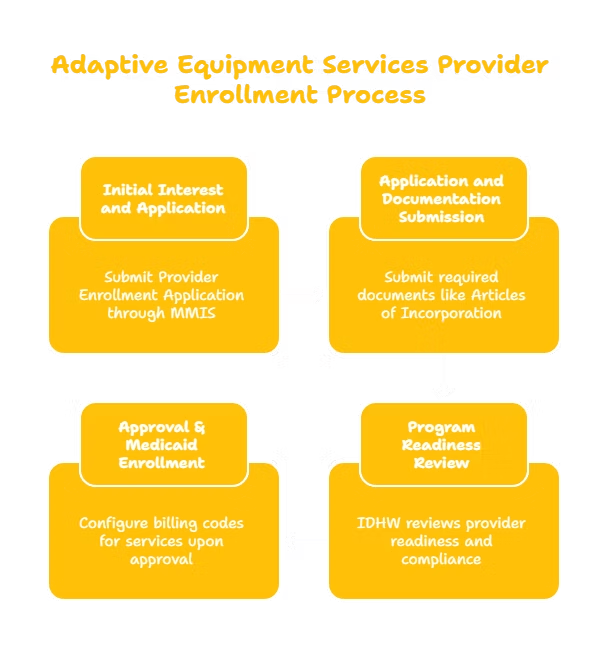
How Does an Agency Navigate the IDHW Provider Enrollment Process?
The enrollment journey is a multi-phase process managed through the Idaho Medicaid Management Information System (MMIS). Initially, providers must submit an enrollment application and provide substantial supporting documentation, including their business licenses, NPI confirmation, and detailed internal policy manuals. This application phase is a critical gatekeeping mechanism that ensures only qualified, prepared providers enter the Medicaid system.
Once the application is submitted, the IDHW conducts a program readiness review. This involves evaluating the provider’s ability to manage participant protections, maintain HIPAA compliance, track service delivery, and process billing claims accurately. Only after this assessment successfully validates the agency’s capacity to operate under Medicaid standards will the provider be authorized to begin configuring billing codes for their specific service offerings, marking the transition from applicant to active provider.
What Staffing and Training Qualifications Are Required?
Staffing is perhaps the most critical component of quality assurance for an adaptive equipment provider. Because the equipment directly impacts a participant's safety and mobility, staff must possess the technical expertise to select and install devices correctly. It is preferred that the program manager or lead specialist holds a certification as an Assistive Technology Professional (ATP) or possesses equivalent, verifiable experience in a clinical or therapeutic field.
Every member of the team, from office staff to delivery technicians, must undergo rigorous training programs. These requirements include:
- Comprehensive training in HIPAA confidentiality protocols and participant rights.
- Specific instruction on the safe handling, installation, and user-testing of adaptive equipment.
- Development of troubleshooting skills for emergency maintenance and repairs.
- Annual refreshers to stay current on new technology advancements and updates to Medicaid regulatory compliance.
Which Medicaid Waivers Authorize Adaptive Equipment Services?
Adaptive Equipment Services are a key component of several Idaho HCBS waiver programs, which are specifically designed to help individuals live safely in their own homes. These include the Aged and Disabled (A&D) Waiver, the Developmental Disabilities (DD) Waiver, and the Children's Developmental Disabilities Waiver. Each of these programs has its own set of participant criteria and authorization workflows.
Providers operating under these waivers must ensure that every piece of equipment provided, and every hour of training delivered, is clearly linked to the goals stated in the participant’s Individualized Service Plan. By maintaining this alignment, agencies ensure that their services remain reimbursable and, more importantly, that they are truly meeting the functional needs of the individuals they serve.
Frequently Asked Questions
What is the typical timeline for starting an Adaptive Equipment provider agency?
The timeline involves several phases: business formation takes 1–2 weeks; the Idaho Medicaid provider application and readiness review generally takes 60–90 days; staffing and procurement setup takes 30–45 days; and final billing system configuration typically takes 45–60 days.
Is an ATP certification mandatory for all staff?
While an Assistive Technology Professional (ATP) certification is preferred for the program manager or primary specialist, not every staff member is required to hold this specific credential. However, all staff must demonstrate appropriate experience and complete the necessary training modules regarding equipment safety, installation, and Medicaid compliance.
How are repairs and maintenance for equipment managed?
Providers are expected to have established systems for both routine maintenance and emergency repairs. These protocols must be clearly documented in the agency’s policy and procedure manual, ensuring that all repairs are performed in a timely manner to maintain the safety and functionality of the device for the participant.
Key takeaway: Success as an Adaptive Equipment Services provider in Idaho relies on a combination of rigorous regulatory compliance, professional staffing, and a commitment to the specific goals outlined in a participant’s Individualized Service Plan. By maintaining high standards of documentation and service delivery, agencies can effectively support the independence of Idaho’s HCBS waiver population while building a sustainable and compliant business model.
Last verified by Waiver Consulting Group on August 2024. The information provided is for educational purposes only and does not constitute legal or professional advice. Requirements for Medicaid provider enrollment can change; always verify current statutes and administrative rules directly with the Idaho Department of Health and Welfare.