ADAPTIVE EQUIPMENT SERVICES PROVIDER IN DELAWARE
By Fatumata Kaba · 2025-07-07 · 6 min read
ENHANCING DAILY FUNCTION AND INDEPENDENCE THROUGH CUSTOMIZED TOOLS, DEVICES, AND SUPPORTIVE TECHNOLOGY
Adaptive Equipment Services in Delaware empower individuals with intellectual, developmental, or physical disabilities by providing essential tools that facilitate mobility, communication, safety, and personal independence. These services are primarily funded through the Delaware Lifespan Waiver, which is administered by the Division of Developmental Disabilities Services (DDDS) and requires that every piece of equipment aligns directly with the participant’s Individual Service Plan (ISP).
Understanding the Regulatory Landscape for Adaptive Equipment Providers
Navigating the governance of HCBS (Home and Community-Based Services) in Delaware requires a clear understanding of the hierarchy of oversight. At the state level, the Delaware Division of Developmental Disabilities Services (DDDS) acts as the primary authority for authorizing, monitoring, and reimbursing adaptive equipment services. They ensure that providers meet specific quality standards and that the equipment delivered serves the clinical needs of the participant.
Above the state level, the Delaware Division of Medicaid and Medical Assistance (DMMA) is responsible for program integrity and managing Medicaid reimbursements, ensuring that all financial transactions adhere to state and federal statutes. Finally, the Centers for Medicare & Medicaid Services (CMS) provides federal oversight, setting the foundational rules for Medicaid HCBS waivers to ensure that participants across the country receive consistent, high-quality care.
What Scope of Services Must an Approved Provider Offer?
The core objective of an adaptive equipment provider is the assessment, procurement, delivery, and ongoing support of devices designed to meet the unique functional deficits outlined in a participant’s ISP. Rather than providing off-the-shelf goods, successful providers act as partners in a person-centered care model, helping participants reduce their reliance on caregivers while increasing their safety and autonomy within their home and community environments.
Approved providers are typically expected to manage the full lifecycle of the equipment, from the initial evaluation of need to final installation and training. The range of support includes, but is not limited to, the following categories of assistance:
- Mobility aids, including gait trainers, walkers, and highly adapted wheelchairs.
- Sensory items and therapeutic equipment designed for specialized sensory processing needs.
- Activities of daily living aids such as adaptive utensils, specialized toileting systems, and dressing assistance tools.
- Communication supports that do not fall under the classification of AAC devices.
- Specialized bedding, postural supports, and seating systems.
- Customization of existing equipment and professional setup, followed by comprehensive training for the user and their caregivers.
Essential Licensing and Administrative Prerequisites
Before an organization can begin serving Delaware residents, it must establish a formal administrative foundation that satisfies both state and federal requirements. This process begins with registering the business entity with the Delaware Division of Corporations and obtaining a federal Employer Identification Number (EIN). Following this, the entity must secure a Type 2 NPI (National Provider Identifier), which is required for organizational billing in the Medicaid system.
Beyond basic business formation, providers must demonstrate professional competence. This involves obtaining proper liability and product insurance to mitigate the risks associated with equipment failure or improper setup. Furthermore, applicants should be prepared to present proof of technical expertise—such as Assistive Technology Professional (ATP) certifications or documented experience in the Durable Medical Equipment (DME) field. Maintaining a robust system for tracking service authorizations and verifying successful delivery is not just a business practice; it is a mandatory regulatory requirement for audit readiness.
The Provider Enrollment Sequence and Ongoing Compliance
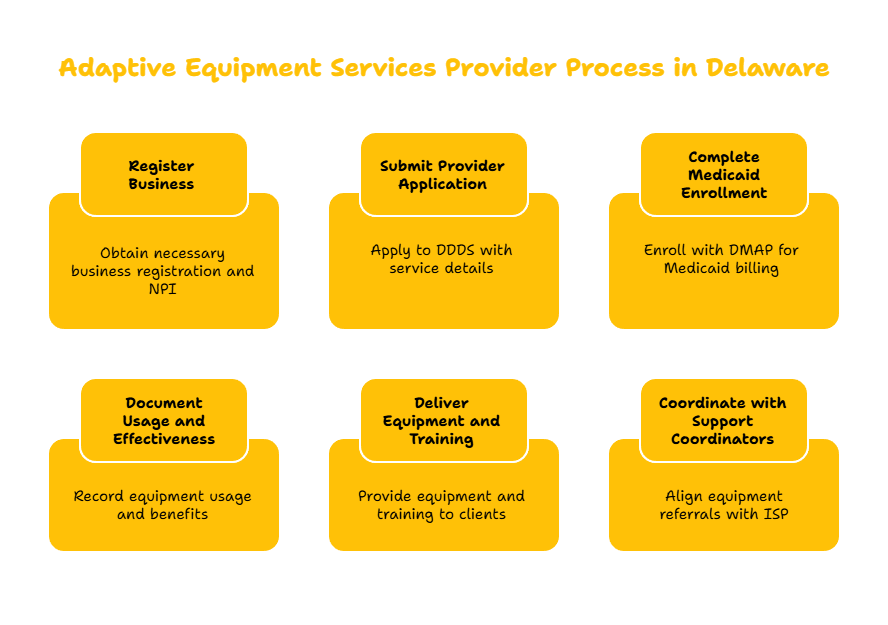
The journey to becoming an approved provider involves a multi-step sequence designed to ensure program integrity. First, the provider must submit a formal application to the DDDS for Adaptive Equipment services, which must include detailed service delivery protocols, organizational structure, and defined staff qualifications. Once the DDDS review is complete, the provider must undergo Medicaid provider enrollment via the Delaware Medicaid Assistance Program (DMAP) portal to become authorized to bill for services.
Once enrolled, the provider enters an operational phase defined by close coordination with Support Coordinators. The Support Coordinator identifies the participant’s need, and the provider ensures the equipment is procured in exact alignment with the ISP. Following delivery, the provider is responsible for ensuring the equipment is functioning correctly, training the user, and submitting documentation that verifies the equipment has met the clinical intent for which it was authorized.
Staffing, Documentation, and Operational Standards
A compliant provider agency must balance technical proficiency with administrative rigor. Staffing should include, at minimum, an Adaptive Equipment Specialist or Technician with hands-on experience in device customization and a Program Coordinator who acts as the primary liaison between the agency, the family, and the Support Coordinator. Every staff member must undergo background checks and receive documented training in HIPAA compliance, participant confidentiality, and the principles of person-centered care.
Internal documentation remains the most critical aspect of the agency's operations. A provider must maintain a comprehensive policy and procedure manual that covers:
- The complete cycle from initial referral and assessment to order fulfillment.
- Delivery verification forms and signatures confirming receipt and successful training.
- Rigorous safety protocols and established procedures for equipment returns, repairs, or replacements.
- Formal incident reporting mechanisms to alert DDDS to any adverse events.
- Consistent maintenance logs for all serialized or custom-fitted equipment.
Frequently Asked Questions
How long does the provider enrollment process take?
The timeline varies based on the completeness of your documentation. Generally, the DDDS enrollment phase takes between 30 and 60 days, while the subsequent Medicaid enrollment through DMAP also typically requires 30 to 60 days. Providers should plan for a multi-month launch window.
Can we bill for repairs of equipment not originally provided by our agency?
In general, service authorizations are tied to specific equipment needs identified in the ISP. If your agency is authorized as the provider for a specific piece of equipment, repairs fall under your scope; however, you must ensure that any repair or replacement is explicitly authorized by the participant's DDDS support team before proceeding.
What happens if the equipment provided is no longer effective for the participant?
Adaptive equipment needs often evolve as a participant’s condition changes. If a device is no longer meeting the functional needs outlined in the ISP, the provider must work with the participant and their Support Coordinator to request an update to the service plan and potentially initiate a new assessment or equipment transition.
Key Takeaway
Launching an Adaptive Equipment Service in Delaware is a commitment to regulatory excellence and clinical accuracy. Success depends on maintaining transparent documentation, upholding strict HIPAA compliance, and fostering strong communication with the Division of Developmental Disabilities Services (DDDS). By aligning your business infrastructure with the specific requirements of the Delaware Lifespan Waiver, you can provide critical, life-enhancing technology to those who need it most.
WAIVER CONSULTING GROUP'S START-UP ASSISTANCE SERVICE — DELAWARE ADAPTIVE EQUIPMENT SERVICES PROVIDER. We help suppliers, assistive technology professionals, and equipment vendors launch fully compliant Adaptive Equipment services through Delaware’s Lifespan Waiver. Scope of Work: Business registration (LLC, EIN, NPI); DDDS provider application and Medicaid enrollment support; Policy & procedure manual for ordering, delivery, and compliance; Templates for intake forms, delivery receipts, and usage verification; Website, domain, and email setup; Staff credentialing trackers and documentation systems; Client intake packet, consent forms, and HIPAA compliance documents; Incident reporting systems and audit preparation tools; Referral networking with DDDS, therapists, and case managers. Our Client Portal offers a wealth of resources that you can explore related to various programs and state requirements.
Last verified: September 2023. Disclaimer: This information is for educational purposes only and does not constitute legal or financial advice. Regulations regarding the Delaware Lifespan Waiver are subject to change, and providers are encouraged to consult directly with the Division of Developmental Disabilities Services (DDDS) and the Delaware Division of Medicaid and Medical Assistance (DMMA) for the most current program guidelines and requirements.