ADAPTIVE EQUIPMENT PROVIDER IN UTAH
By Fatumata Kaba · 2026-04-01 · 5 min read
Becoming an approved Adaptive Equipment provider in Utah requires a strategic alignment with the Department of Health and Human Services (DHHS) and the Division of Services for People with Disabilities (DSPD). These agencies oversee the specialized procurement, installation, and maintenance of devices that allow individuals with disabilities to maintain independence and safety within their homes and communities.
To succeed in this sector, providers must demonstrate rigorous adherence to state-mandated documentation, clinical justification processes, and Medicaid billing standards. This guide outlines the regulatory framework and operational prerequisites necessary for organizations aiming to participate in Utah’s Home and Community-Based Services (HCBS) waiver programs.
Understanding the Role of Adaptive Equipment in HCBS Waivers
Adaptive equipment serves as a cornerstone of person-centered care, bridging the gap between an individual's functional limitations and their desire for autonomy. By providing tools that facilitate daily living—such as mobility aids, communication tablets, or environmental modifications—providers help reduce the need for more restrictive, facility-based care settings. These services are authorized based on medical necessity, requiring that each piece of equipment directly correlates to a goal identified in the participant's Individual Support Plan (ISP).
In Utah, the responsibility for oversight is shared among key state bodies. The DSPD is the primary entity that approves providers, authorizes funding, and ensures that all equipment procurement is consistent with the participant’s care plan. The Division of Integrated Healthcare (DIH) handles the administrative and financial side, managing Medicaid provider enrollment and reimbursement. Understanding this hierarchy is essential for providers to navigate the intersection of clinical justification and fiscal accountability.
Navigating the Utah Medicaid Provider Enrollment Process
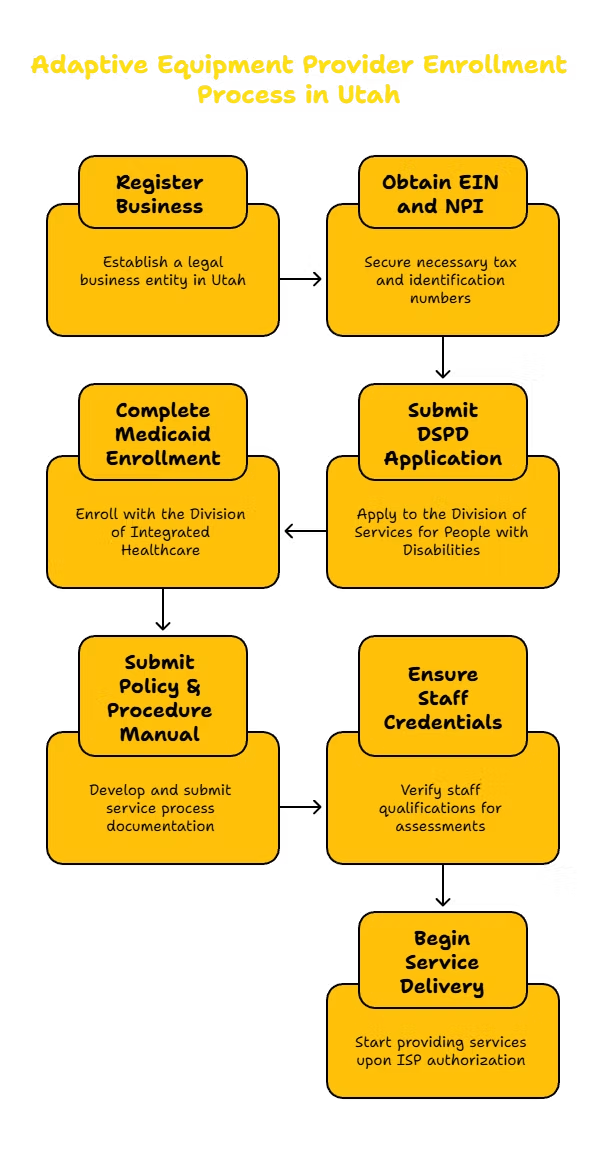
The journey to becoming an approved provider begins with formal business registration and enrollment. Prospective agencies must first register with the Utah Division of Corporations and obtain a Federal Employer Identification Number (EIN) and a Type 2 National Provider Identifier (NPI). These are the foundational credentials required for any entity seeking to bill state and federal healthcare programs.
Once registered, the provider must submit a formal application to the DSPD for the specific Adaptive Equipment service code. This process involves proving that the agency is capable of meeting the clinical and safety standards expected by the state. Following DSPD approval, the organization must complete the Medicaid enrollment process through the DIH portal. Throughout this phase, maintaining clear documentation of business formation and organizational capacity is critical, as state auditors will verify these details before approving a provider for active service delivery.
Developing Comprehensive Policies and Procedures
A robust Policy & Procedure Manual is the most critical document for a new Adaptive Equipment provider. It serves as both a compliance tool for state audits and an operational roadmap for staff. The manual must detail how the agency manages the entire lifecycle of a piece of equipment, from the initial clinical assessment and order placement to delivery, setup, and long-term maintenance.
Providers must include specific protocols regarding safety checks and installation procedures to mitigate liability. Furthermore, policies must address privacy and HIPAA compliance, ensuring that all client records—which often include sensitive clinical justifications—are handled according to federal and state standards. Because the equipment provided often has a significant impact on a participant's physical safety, the manual must also explicitly outline grievance procedures, ensuring that the participant or their guardian has a clear path for resolving concerns about equipment functionality or service quality.
Staffing Requirements and Clinical Competencies
Success in this field hinges on the expertise of staff members who handle the physical and clinical aspects of service delivery. An Adaptive Equipment Specialist or Technician must be trained in the specific installation and maintenance of the devices provided. Often, this requires specialized manufacturer training to ensure that the equipment functions exactly as intended. These technicians are responsible for conducting safety inspections that verify the equipment remains compliant with manufacturer specifications over time.
When the equipment requires a clinical assessment to determine its medical necessity, staff with appropriate credentials—such as licensed Occupational, Physical, or Speech Therapists—must be involved. These professionals must hold valid Utah state licensure and possess experience in assistive technology or environmental modifications. Their role is to interface with the participant’s care team, ensuring that the equipment selected is not only functional but also aligned with the participant's long-term person-centered goals as documented in the ISP.
Integrating Equipment Services with Waiver Programs
Adaptive Equipment is a covered service across several Utah Medicaid waivers, including the Community Supports Waiver (CSW), the Acquired Brain Injury (ABI) Waiver, the Physical Disabilities Waiver (PDW), the Medically Complex Children’s Waiver (MCCW), and the New Choices Waiver (NCW). Each waiver has its own nuances regarding what is considered "medically necessary" and "cost-effective." Providers should familiarize themselves with these definitions to ensure that the equipment requested has a high probability of authorization by the DSPD.
Consistency is key to integration. Equipment must be explicitly listed in the ISP, and the provider is often tasked with providing the clinical justification that links the device to the participant’s specific functional needs. Because funding for these items is tied to waiver-specific budgets, providers should maintain open communication with support coordinators. This collaborative approach helps prevent billing delays and ensures that participants receive the equipment they need in a timely manner.
Frequently Asked Questions
What types of equipment are typically covered?
Coverage is broad but must be medically necessary. Common examples include wheelchair ramps and lifts, shower chairs, grab bars, bed rails, specialized eating utensils, speech-generating tablets, environmental controls like switch-activated lights, and vehicle modifications.
Do I need to be licensed to sell adaptive equipment in Utah?
While the business entity must be registered, specific clinical assessments often require staff to hold state licensure through the Division of Occupational and Professional Licensing (DOPL), such as a licensed therapist, if they are performing the evaluation for the equipment.
How long does the provider enrollment process take?
The total timeline varies, but generally, business formation and manual development take 2–4 weeks, followed by a 1–3 month period for DSPD and Medicaid enrollment. Staff training usually runs concurrently or immediately after the enrollment phases.
Key Takeaway
Establishing an Adaptive Equipment provider agency in Utah requires meticulous preparation, centering on strict adherence to DSPD and DIH regulatory standards. By investing early in a comprehensive policy manual, securing properly licensed staff for clinical evaluations, and maintaining a clear, documentation-first approach to service delivery, agencies can effectively support the independence of waiver participants while maintaining long-term Medicaid compliance.
Last verified: 2024. This information is provided for educational purposes and should not be considered legal or financial advice. Consult with the Utah Division of Services for People with Disabilities (DSPD) and the Division of Integrated Healthcare (DIH) for the most current regulatory updates and specific enrollment requirements.